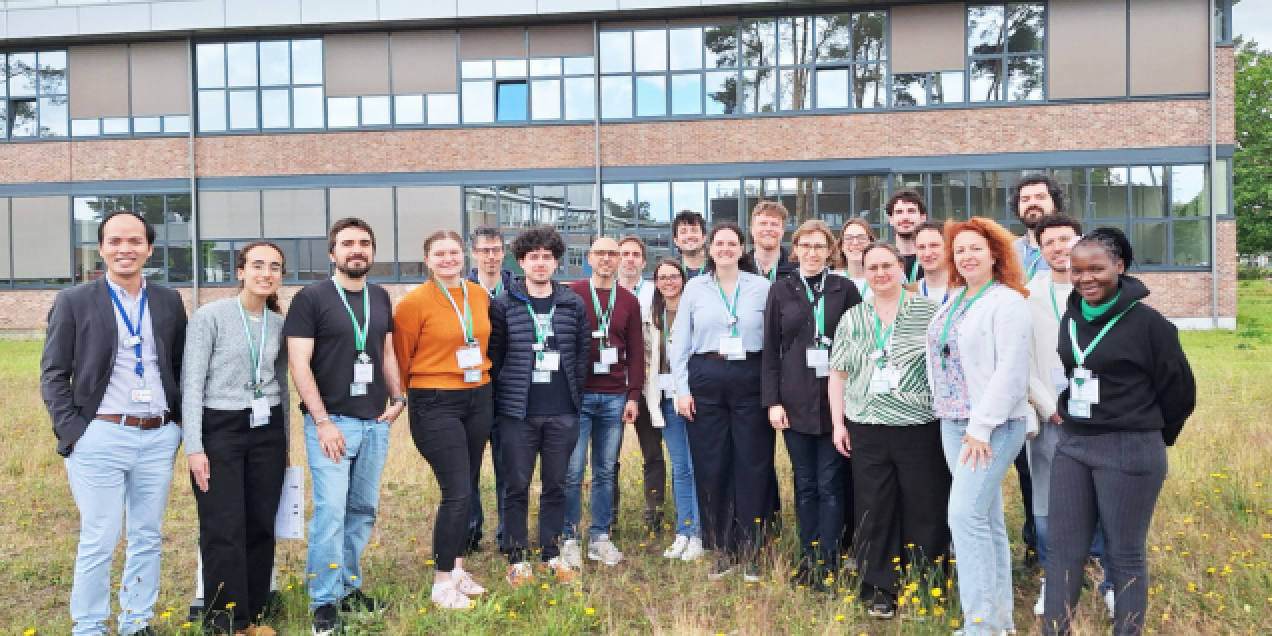
Symbolic start for surface disposal in Dessel
SCK CEN congratulates NIRAS on this important milestone
With the exhibition In Time and the planting of a tree at the future site, NIRAS officially launched the construction phase of the surface disposal facility in Dessel. These symbolic events mark the beginning of a new chapter in Belgium’s management of low-level, short-lived radioactive waste. The tree represents growth, future, and the deep-rooted collaboration, expertise, and scientific foundation behind the project.
SCK CEN warmly congratulates NIRAS on this milestone. As a research centre, we are proud to have contributed to the scientific groundwork of this initiative. Our role has been supportive, yet essential in ensuring long-term safety and sustainability.

Scientific support from SCK CEN
1. Long-term safety through geosystem analysis
The EGA (Engineered and Geosystems Analysis) group at SCK CEN has been closely involved in the surface disposal of low- and medium-level short-lived waste since 1998. The project phase of the surface disposal site in Dessel, in which EGA is making some major contributions in a variety of areas, first began in 2006. The group's expertise was also indispensable as far as the safety aspects of the surface disposal site were concerned. In the future, the group is set to make further significant contributions to the project, including updates to the safety calculations and the development of the covering test. Let's take a look at each aspect in turn.

Thinking thousands of years ahead – analysing the scenarios
What they are doing is developing advanced models that simulate the behaviour of radioactive substances in the repository over the next 2000 years, in order to estimate how long and to what extent the repository will remain intact. As part of that process, they not only take account of natural effects such as precipitation and erosion, but also of potential nuisance caused by humans or wildlife, earthquakes, airplane crashes or the drilling of deep holes.
For each radioisotope present in the waste, models have been drawn up to simulate their behaviour inside the repository. Those models chart the way in which the radioactive particles attach themselves to materials and the likelihood of them breaching the barriers.
Slow release, safe dose
The repository will consist of multiple protective layers. Combining these materials in that way will ensure that the waste is exposed to water as little as possible and that the radioactive particles are released only slowly. In all scenarios for which modelling was performed, the total dose or the risk to humans and the environment remains below the strict standards laid down by the FANC and by international authorities and therefore poses no danger to the surroundings.

Flows of water under control: the hydrogeology of the tumuli
The hydrogeology of the site was also subjected to a thorough investigation. The disposal site will consist of two tumuli – hills of earth under which the waste will be stored away safely inside the mainly concrete installations. Water plays a crucial role in the safety of this construction. For that reason, extensive modelling was carried out to determine the movement of ground water and rainwater in, around and above the tumuli. The robust and conservative models produced by EGA provide a precise picture of the current and potential future conditions on the site. The impact on the water table in the surroundings has also been charted in a highly detailed way. These insights are essential in order to estimate the potential dissemination of radio-isotopes in water correctly.

Testing for the future: the cover test
Though construction of the repository is already getting under way, not all of the details are known at present. Around 50 years from now, a permanent cover will be placed on top of the structures. This will consist of various natural and artificial protective layers with vegetation on top. Investigations still need to be carried out to identify how that cover will behave on a long-term basis.
For that reason, a major cover test is being developed, which EGA is helping to design. This test will involve an extensive network of instrumentation and sensors and will incorporate the expertise of EURIDICE. This will enable researchers to monitor the performance of the cover with a high degree of precision and to take action where needed.
Learn more about how we support safety and performance assessments through science.
2. Optimising the disposability of low- and medium-level short-lived waste with the help of RDD
The RDD (R&D Disposal) group at SCK CEN is heavily involved in the ‘disposability’ aspect of the surface disposal project. Research into the types of waste and barriers that will be used at the facility is ongoing. Through their experiments, RDD colleagues measure how strongly radionuclides adhere to the cement materials used to treat low- and medium-level short-lived waste. This information will be used to update the safety calculations, enabling the disposal of certain category A waste streams to be optimised further.
3. Environmental impact studies for humans and the environment
Since 2010, the BIS group (Biosphere Impact Studies) at SCK CEN has been carrying out radiological environmental impact assessments (REIAs) for the various exposure scenarios involving low- and medium-level short-lived waste that may occur in the long term. These studies are essential when evaluating the safety of surface disposal and are updated regularly.

In 2022, for example, an extensive update of the study was produced that included a number of important deliverables:
- A full report concerning the impact assessment or an in-depth analysis of the potential effects of the installation on humans and the environment, based on the most up-to-date scenarios and model parameters.
- A QVV (Qualification, Validation and Verification) report from the ERICA tool, specifically applied to non-human biota. This report underpinned the scientific reliability of the methodology used.
- An informative project memorandum for the FANC.
- Helping ONDRAF/NIRAS respond to questions and comments from the safety authorities.

Earlier this year, another complete update was produced. This time, the focus was specifically directed towards non-human biota. The reason for this was the revision of the reference scenario for leaching developed by the EGA group. The update involves:
- A recalculation of the radiation doses for flora and fauna, based on the latest source term data.
- A fine-tuning of calculations in line with changes to the leaching model
- The further integration of ecological considerations in an area that traditionally focused heavily on human safety.
These studies form an essential part of the dossier to be submitted by ONDRAF/NIRAS to the safety authorities and play their part in ensuring that the decision to grant a licence is backed by suitable scientific evidence.
Learn more about how we assess radiological impact on people and the environment.
Sincerest congratulations to ONDRAF/NIRAS
The laying of the foundation stone not only marks the beginning of a new phase of the surface disposal project, but also provides us with an opportunity to acknowledge the shared process that led up to this point. SCK CEN sends its heartfelt congratulations to ONDRAF/NIRAS on achieving this milestone.
We are proud of the many years of collaboration, in which scientific depth, open dialogue and mutual trust have played a key part. Together, we have worked to construct a robust foundation for a safe and sustainable solution for low- and medium-level short-lived waste in Belgium.
Congratulations, ONDRAF/NIRAS, on behalf of all of the colleagues involved, and every success as you continue working to make this important repository a reality!