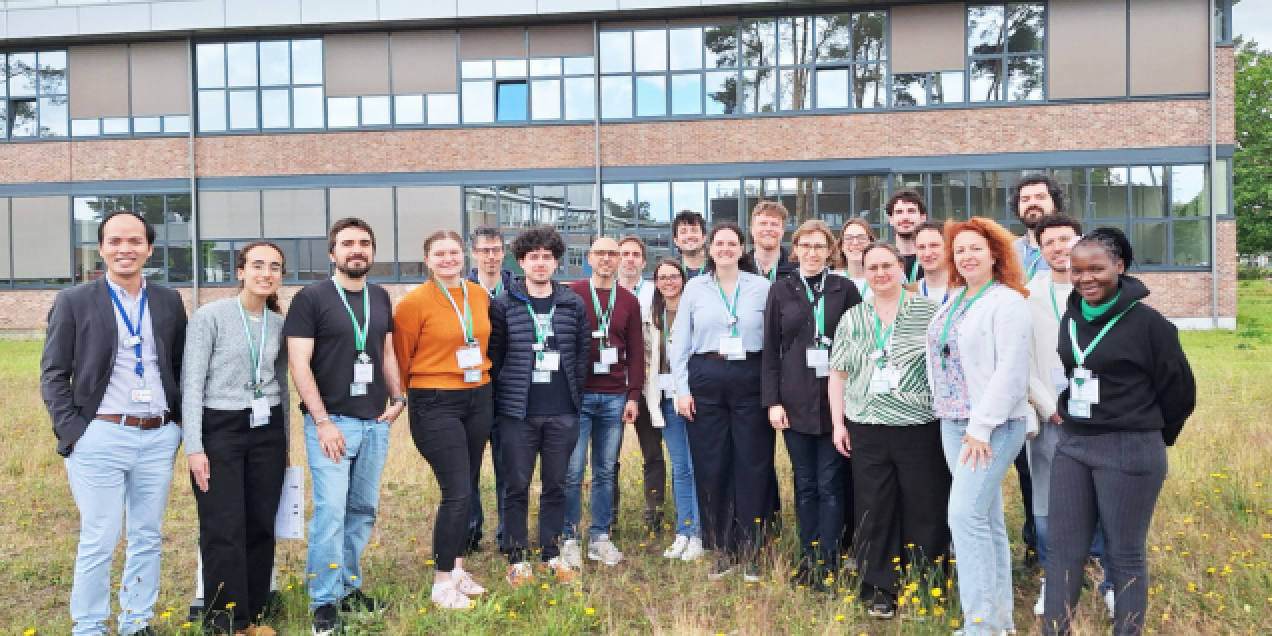
Renewed research and technical support partnership: SCK CEN and NIRAS-ONDRAF strengthen Belgium’s programme on radioactive waste management
Belgium's radioactive waste management programme has steadily matured over the decades, built on a long-standing and productive relationship between SCK CEN and NIRAS-ONDRAF. As the programme evolved, so did the nature of that collaboration: what had been for a long time a client-provider relationship has grown into a real partnership, formalised five years ago to better integrate R&D efforts on both sides. The goal was easy to say yet harder to build: a genuinely shared approach to support the Belgian programme, aligning the research priorities of NIRAS-ONDRAF and SCK CEN, translating needs into clear goals and objectives, and securing the infrastructures and competencies that Belgium must keep at home. Deciding to form a partnership is only the first step; turning it into reality requires more. Let’s explore how our partnership is structured and how it came into being.

What the Last Five Years Taught Us
Experience from the first years of the partnership shaped a stepwise process that has become the backbone of how we work today: defining programme lines, setting priorities, anchoring competencies, securing infrastructures and mapping 10‑year goals into 3-year objectives. This involves the whole team and is coordinated by a coordination committee of three NIRAS-ONDRAF experts and three SCK CEN experts.

Organise for the long haul
Strategically, we identified four programme lines for the Belgian programme on radioactive waste management. Each of these programme lines require continuous RD&D regardless of the stage and level of maturity, with research continuing well beyond the operational phase of the disposal.
- Waste
Research remains necessary on the various types of radioactive waste that we have, from cradle to grave.
- Surface disposal
Low- and medium-level short-lived waste will be disposed of in the surface repository in Dessel. Construction of this repository has already started, but the RD&D on various types of waste to be disposed of, continues.
- Near surface disposal
For Radium-bearing waste from historical industrial radium production, the foreseen solution would be a near surface disposal facility. Even though the Belgian programme awaits policy decisions, we will be ready to tackle this within our partnership
- Deep disposal
Deep disposal of highly radioactive and long-lived waste has been researched in Belgium for decades already, with our joint underground research lab HADES as the centre point and main tool. This RD&D will continue in the years to come, while focussing on our joint goal of a final disposal facility. This will remain necessary in the coming decades, even following the site decision and the granting of licences.
To achieve a successful collaboration throughout the four programme lines, the partnership is organised around 8 domains that mirror the Belgian context and our shared view of what it takes to develop a sound, comprehensive programme. SCK CEN scientists work together with NIRAS-ONDRAF colleagues in each domain.
8 research domains
-
We will inspect and study used nuclear fuel rods, learning from past work and improving our tools to understand how the fuel changes over time. Using this knowledge, we will deliver input for decisions on the long-term management of spent fuel.
-
We are studying how certain waste materials behave over time so we can manage them safely and understand how they will act in under disposal conditions. At the same time, we are developing clear treatment methods for waste streams that currently lack solutions and improving non‑destructive techniques to better examine and monitor waste without opening the drums they are stored in.
-
We are preparing for future cement technologies by learning how new low‑carbon cements might affect waste management and by strengthening our expertise in safely cementing difficult waste types. We are also developing models and testing materials to understand the stability of cement‑based barriers and cemented waste forms, ensuring the long‑term reliability.
-
THMC-Gas stands for Thermo-Hydro-Mechanical and Chemical behaviour of and Gas transport through the engineered barriers and the host rock, which, in the case of our underground research lab HADES, is the Boom Clay. The goal of this domain is to validate our understanding of the clay behaviour at relevant scales, prepare site characterisation and transfer knowledge to other depths/host rocks.
-
To support several domains (THMC-Gas, migration, monitoring), it is of crucial importance to keep HADES maintained and safe. Moreover, HADES delivers crucial input for the final design of the deep disposal facility. Indeed, the observations of the behaviour of different lining sections of HADES in contact with the Boom Clay over four decades (and counting) are invaluable to assess long-term gallery stability.
-
We are improving our understanding of how radioactive materials move through engineered barriers and – for deep disposal – the host rock by updating key scientific data, refining models, and setting clear methods for measuring water and soil conditions at potential disposal sites.
-
We are building a stronger monitoring culture—with good data practices and shared tools—to support safe, long‑term oversight of facilities like the surface disposal facility in Dessel.
-
Within the Belgian programme on radioactive waste management, we focus on communicating about our joint research activities and achievements, both for the general public and dedicated stakeholders.
Learn more about our joint infrastructure HADES on the dedicated website
Anchor crucial competencies in Belgium
Crucial competencies can be found across the entire waste‑management chain and all the domains that are listed. Anchoring these competencies in Belgium is vital to preserve our national expertise and make sure we will be able to design, evaluate, construct and operate the current and future disposal facilities.
Transversal skills such as data and knowledge management and technological watch ensure continuity and adaptability. Moreover, we will keep our unique infrastructure fit-for-purpose by key investments.
Mature flagship experiments and methods
We prepared and launched work that now matures: the large-scale in situ tests in HADES remain crucial as PRACLAY transitions into its cooling phase and NEMESIS consolidates understanding of gas transport, while the long-term, meter-scale radionuclide migration tests continue to be followed up. Moreover, long-term leaching experiments with real spent fuel keeps our grasp on radionuclide release realistic. In addition, in‑pool measurements and the design of a next-generation detector (a collaboration with Euratom) strengthen the spent fuel database. The RD&D on specific waste forms such as bituminised waste and ASR sensitive waste deepen disposability insights. Our combined expertise in construction and instrumentation will allow us to soon construct a large-scale test cover to investigate the materials to be used to cover the surface repository after the operational phase, which will last a few decennia. Maintaining knowledge and transferring it to the generations to come, is thus also key to our partnership.
What SCK CEN Brings to the Table
- Unique infrastructure in Belgium: hot cells for destructive/non-destructive spent fuel examinations; labs for radioactive waste behaviour and migration of radionuclides; LINAC for imaging of waste drums; cementation upscaling facility; the MaT building for treatment & conditioning; modelling capacity to connect data to design;
- Over four decades of unique expertise and competencies in designing and running long-term experiments for in situ science in HADES, the underground laboratory that is operated by EURIDICE, an SCK CEN and NIRAS-ONDRAF partnership;
- A culture of measurement and learning: multidecade joint experiments (PRACLAY, NEMESIS, radionuclide migration) for which our expertise in instrumentation and monitoring is crucial.
A Promise for the Next Decade
Over the next ten years, we will validate and further extend our knowledge in support of the development – and for the case of surface disposal, the implementation – of solutions for the long-term management of radioactive waste. This is inherently a long-term, stepwise endeavour, matching the timescales of the programme itself: we will focus where most needed at this stage while keeping an eye on what the needs of the next stages could be. We will also preserve the competencies and research infrastructures that must stay in Belgium and contribute data and tools for informed national decisions.
This renewed partnership between SCK CEN and NIRAS-ONDRAF is also transformative. It marks a structural improvement of the integration, consistency and coherency of joint RD&D activities driven by a shared vision. This can only yield more pertinent, more useful and higher quality research to the benefits of all parties. Together, we want to ensure a partnership built to last.