The second construction phase of MINERVA is about to begin
A public consultation for the second phase of MINERVA will take place from 1 to 29 November. MINERVA is the starting point of MYRRHA’s particle accelerator. With the MINERVA project, the nuclear research centre SCK CEN aims to address a variety of societal challenges. The file, including the ambition and technical plans, will be available to read at Mol town hall (Molenhoekstraat 2, 2400 Mol).
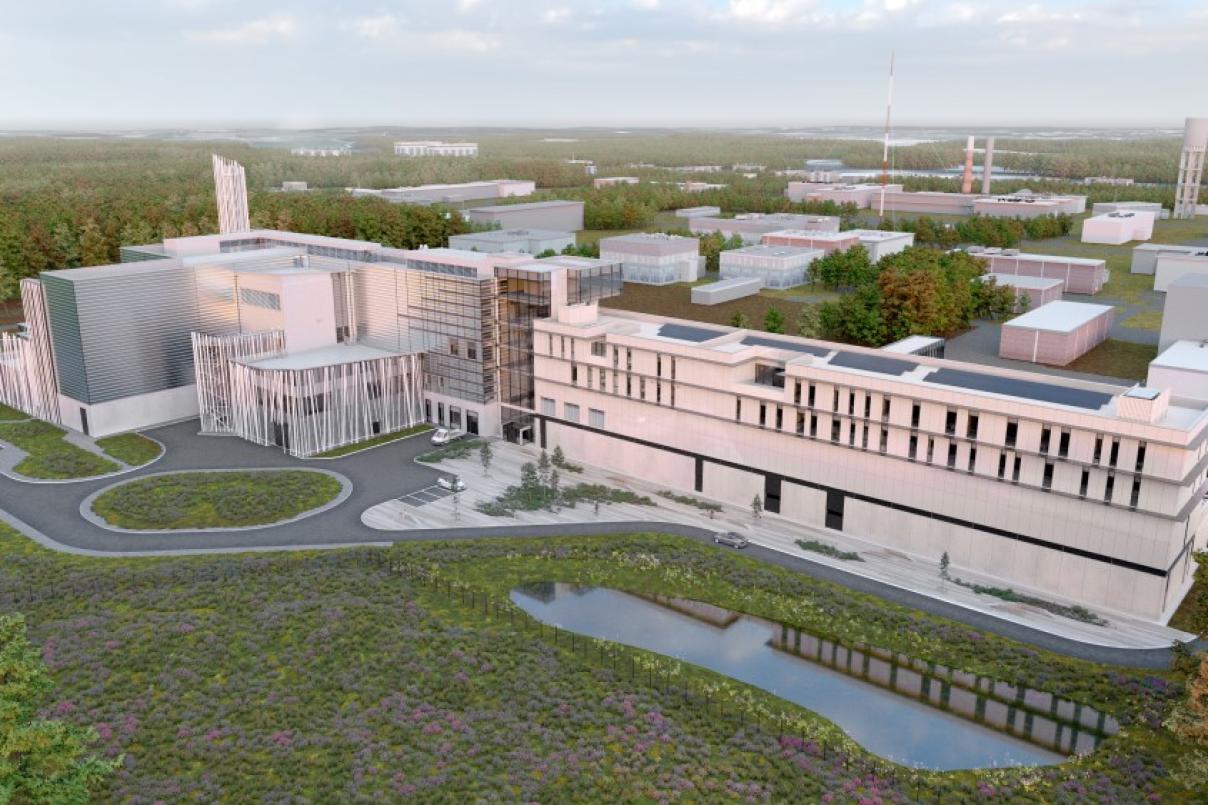
MYRRHA will be the world's first multifunctional research reactor driven by a particle accelerator. When the particle accelerator is switched off, the chain reaction automatically stops and the reactor shuts down within a millionth of a second. With MINERVA, the first part of MYRRHA, the nuclear research centre SCK CEN aims to contribute to the development of a new generation of medical radioisotopes, fundamental scientific research and material testing for fusion reactors. The first part of the particle accelerator is called 'MYRRHA Phase 1 - MINERVA'.
Construction process
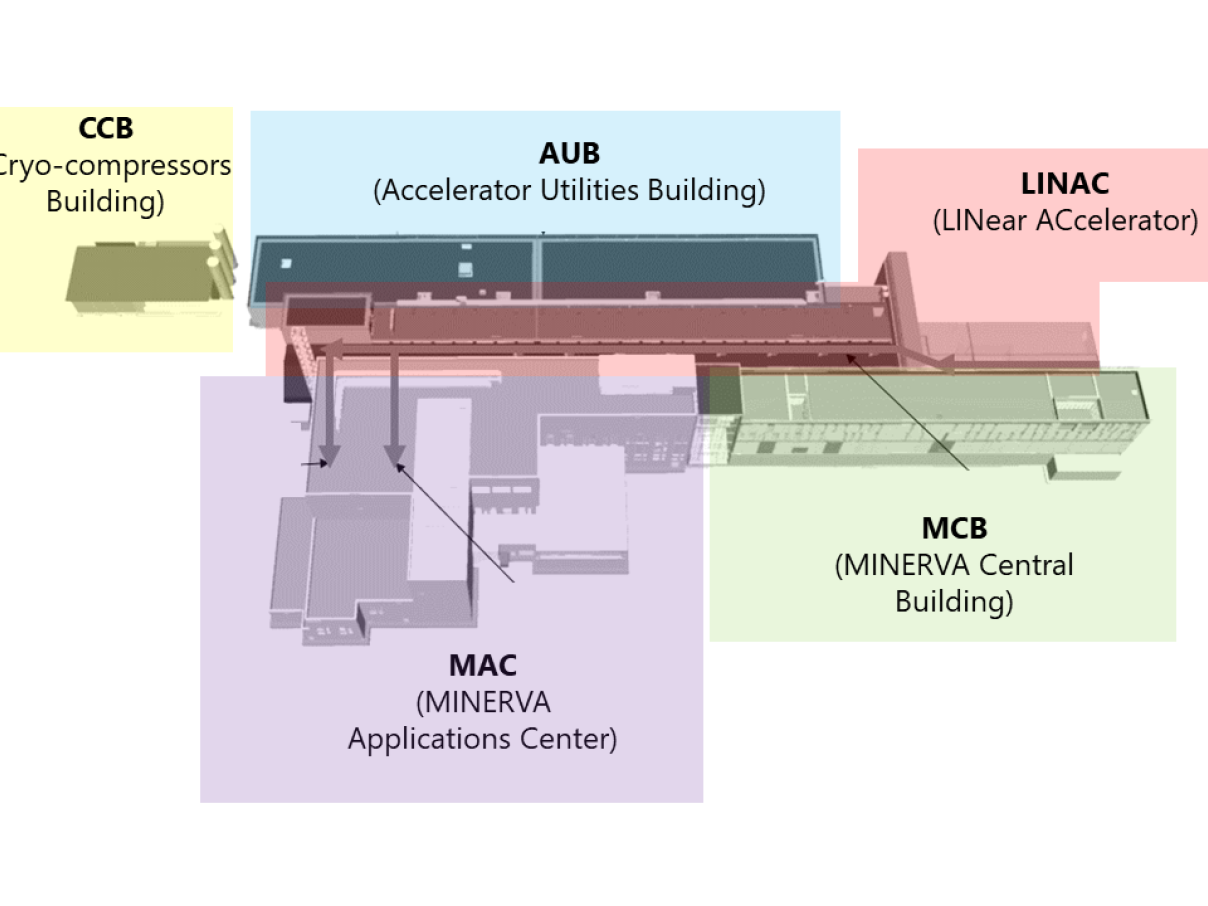
In total, MYRRHA Phase 1 - MINERVA consists of five buildings. Its construction is also proceeding in several stages. SCK CEN has now submitted an application for an environmental licence to begin the second stage. In this stage, SCK CEN will realise the remaining three buildings:
- The MINERVA Central Building (MCB), where the 'heart' of MINERVA's particle accelerator will be located. This refers to the injector that delivers the first protons. Office spaces and conventional functions will occupy the floors.
- The LINAC, which will house the particle accelerator itself. MINERVA will accelerate protons to an energy of up to 100 Mega-electronVolt (MeV).
- The MINERVA Applications Centre (MAC), where irradiation stations will be housed. In these stations, the team will fire part of the proton beam to test materials for fusion reactors, conduct basic research, and produce a new generation of medical radioisotopes. The latter relates to research quantities.
Construction stage 1
In an earlier construction stage, these buildings were realised:
- Cryo-compressors Building (CCB): In order to accelerate MYRRHA’s proton beam, superconductivity is required. Superconductivity is the phenomenon whereby electrical resistance of some materials vanishes below a certain temperature. The temperature needed for MYRRHA is 2 kelvins. The cryomodules that provide these ideal conditions are powered by auxiliary systems in the CCB building.
- Accelerator Utilities Building (AUB): This building is the technical area of the particle accelerator. It houses all the technical equipment: ranging from HVAC to electricity.
Environmental licence
The environmental licence application covers both urban planning and environmental aspects. Realisation of the project will require the partial felling of a forest. Compensation for these trees has been arranged. All of this has been discussed in an environmental impact assessment report (EIA). An information meeting on the subject will follow.
Information meeting
You can attend the information meeting on Wednesday 12 November, from 5pm to 7pm, in the Lakehouse, during which SCK CEN and consulting firms SWECO and Bureau DW will present the plans to residents and other interested parties. Interested parties can also submit any questions in advance to info [at] sckcen [dot] be (info[at]sckcen[dot]be).