Research into advanced waste characterisation and better calibrations for cancer treatment thanks to the installation of a second-hand LINAC
LINAC@LNK project takes a leap forward
The LINAC@LNK project has reached an important milestone with the installation of a linear accelerator (LINAC) in the LNK building on the site of SCK CEN, the Belgian Nuclear Research Centre. This marks the start of a new phase of research into both advanced waste characterisation and better calibrations for cancer treatment.

What is LINAC@LNK?
The project, which started at the end of 2023, uses a second-hand medical LINAC for two main research objectives: improving calibrations for cancer treatment (radiotherapy) and characterising radioactive waste. LINAC@LNK has received 1 million euros from Belspo, and SCK CEN is collaborating with NIRAS/ONDRAF on the project. Learn more about LINAC@LNK.
-

Goals in the medical and calibration fields
In radiation therapy, LINACs deliver high doses of ionising radiation to kill cancer cells, requiring precise calibration to ensure effective treatment and avoid radiation errors. Cobalt-60 (1.3 MeV) is currently used for calibration, but its lower energy compared to hospital LINACs (6 to 18 MV) requires correction factors, increasing uncertainty. The LINAC@LNK project aims to increase calibration accuracy by using a medical LINAC directly, thus reducing the dependence on correction factors. Additionally, the project will advance research in dosimetry and nuclear medical applications, including the development of new radiation protection detectors, imaging techniques such as CBCT, and studying cancer therapies that combine external beam radiotherapy with radionuclides.
-
Goal for waste characterisation
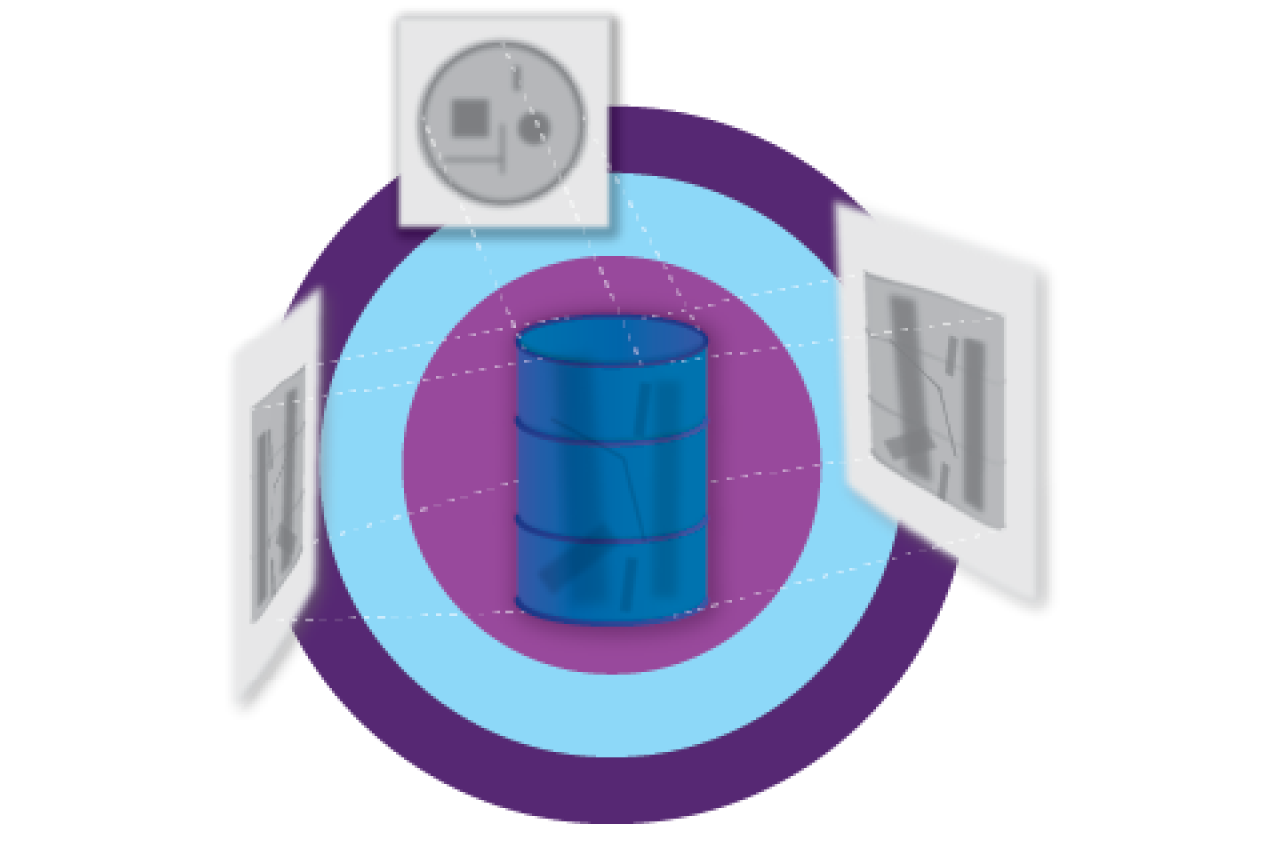
One of the objectives of LINAC@LNK is to check whether historical drums stored at Belgoprocess since the 1980s meet the current Waste Acceptance Criteria (WAC) for surface disposal. The LINAC technology offers an innovative, non-destructive method to analyse the contents of these drums without physically opening them, significantly improving the operational safety and efficiency of the process.

Successful pilot study
A major breakthrough in the LINAC@LNK project was the successful pilot study on waste characterisation in late 2023. The goal of this study was to demonstrate that the technology of a medical LINAC can be effectively used for non-invasive inspection of waste drums. The tests were conducted at ZNA Jan Palfijn in Antwerp, subject to the availability of the LINAC.

Quiz question for the X-ray picture
What was inside the mock-up drum used for the pilot study at ZNA Jan Palfijn in Antwerp?
The mock-up waste drum contains 5 different super compacted discs, conditioned in a cementitious matrix (mortar).
From top to bottom:
- Disc 1: Air extraction filter
- Disc 2: PVC + Polyethylene
- Disc 3: Paper + Cardboard
- Disc 4: Wood
- Disc 5: A mix of concrete, metal, gyproc (plaster), aluminium (approx. 10 kg), polyethylene (approx. 20 kg), rock wool
LINAC installation and next steps
In February and March 2025, the supplier, Varian, installed a second-hand LINAC, from UZ Leuven, at the SCK CEN site.
From April 2025, the project team will move up a gear: the LINAC will become operational, and both medical and waste research will gain momentum.
- Regarding waste characterisation, the LINAC will be used to produce detailed 2D and 3D images of the contents of the waste drums. These images will help to determine both the physical and chemical properties of the waste. The technology represents a significant step forward in the safety and efficiency of radioactive waste management.
- Regarding calibration, we will develop a new workflow for calibrating ionisation chambers used in radiation therapy, contributing to more accurate and effective cancer treatments.
Want to know more?
Read more on our website.