New calibration service from SCK CEN aims to advance standardisation in nuclear medicine
The nuclear research centre SCK CEN is expanding its calibration services. From the summer of 2025 onwards, hospitals can call upon SCK CEN to have their radionuclide calibrators for nuclear medicine calibrated. Those devices are used to check the activity before it is administered to a patient. SCK CEN received ISO 17025 accreditation for its calibration services. Having obtained that accreditation, SCK CEN is hoping to help harmonise measurements in accordance with international standards.

This latest expansion comes at a time when nuclear medicine is gaining importance. After all, hospitals worldwide use radionuclides as a means of detecting cancer and, for a few years now, for the purpose of treating the disease as well. This involves administering a radiopharmaceutical drug to the patient, which targets cancer cells in the body. So that the tumour receives the correct dose, the activity of each injection is precisely measured using a radionuclide calibrator. Calibrating the calibrators ensures reliable and consistent results. Since the summer of 2025, hospitals have been able to call upon the nuclear research centre SCK CEN to provide that service.
Calibrations of this type are not a legal requirement, but are strongly encouraged. “In most fields of metrology, international standards are taken for granted. Take height or weight, for example. We would find it hard to imagine how a kilogram could weigh more in Spain than in Belgium. The same thing therefore applies in the case of nuclear medicine. If we want to compare parameters such as the response to treatment from country to country based on the administered dose, we need to speak a common language. Calibration is the way of achieving that,” said Filip Vanhavere, an expert in dosimetry and calibration at the nuclear research centre SCK CEN. Although hospitals perform measurements in a logical and consistent way, differences between hospitals do occur. The call to calibrate those devices in accordance with international standards is therefore getting louder and louder. Meanwhile, a new IEC/DIS 63465 standard is being prepared on an international level.
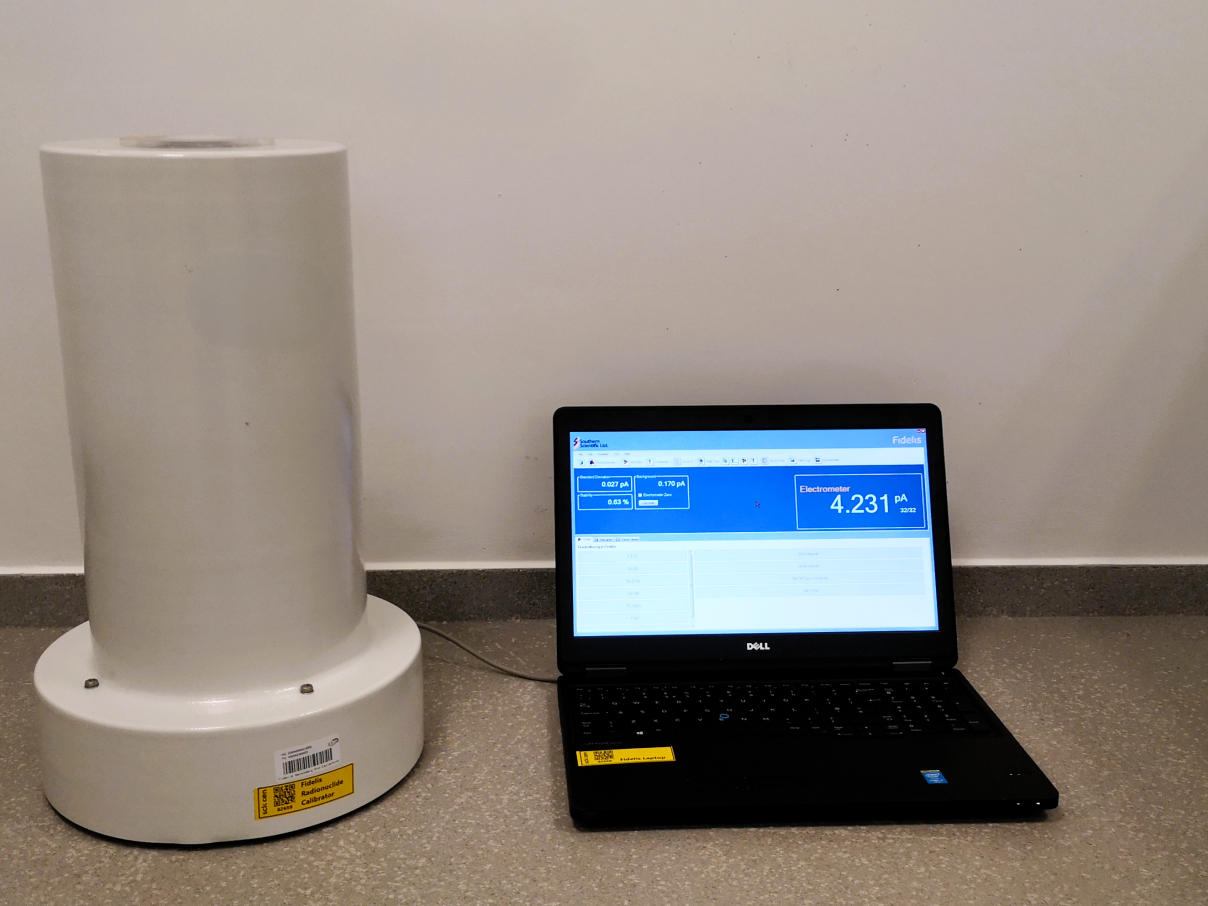
That standard is intended to address the growing need to harmonise measurements and guarantee certainty with regard to the injected activity. It allows scientists to establish the relationship between the activity, the result of scans and the absorbed dose. With that information, they can get to work in order to optimise treatments. That is the reason why SCK CEN is expanding its calibration services to include radionuclide calibrators. “Since last year, we have been officially accredited by BELAC to perform that calibration in accordance with the ISO/IE 17025:2017 standard. This means that we are the first and only accredited institution in Belgium,” explains Filip Vanhavere. In the meantime, the first calibrations have already taken place.
Focus
SCK CEN calibrates radionuclide calibrators for a wide range of radioisotopes. This includes commonly used radionuclides such as technetium-99m, gallium-68, fluorine-18 and iodine-131, as well as more specialised isotopes such as lutetium-177, terbium-161 and actinium-225. The list can be customised, based on the specific needs of each hospital.
This calibration service is provided by the Laboratory for Nuclear Calibrations at SCK CEN.
Get in touch with them or view details about all calibration services.

LNK – Laboratory for Nuclear Calibrations
Commissioned in 2021, the Laboratory for Nuclear Calibrations, or LNK for short, is the calibration building at the nuclear research centre SCK CEN. The building itself provides SCK CEN with six separate irradiation rooms, thereby guaranteeing a high degree of flexibility when it comes to performing multiple irradiations in parallel. Thanks to this facility, the nuclear research centre is one of the highest-ranking in Europe. On the one hand, the building is used to calibrate measuring devices in accordance with international standards, and on the other, to irradiate experiments such as prototypes of dosimeters, cells, and other research samples. These standards create uniformity and clarity worldwide, enabling researchers to maintain consistency in their work.