SCK CEN also pins on a yellow ribbon for 'Day against Cancer'
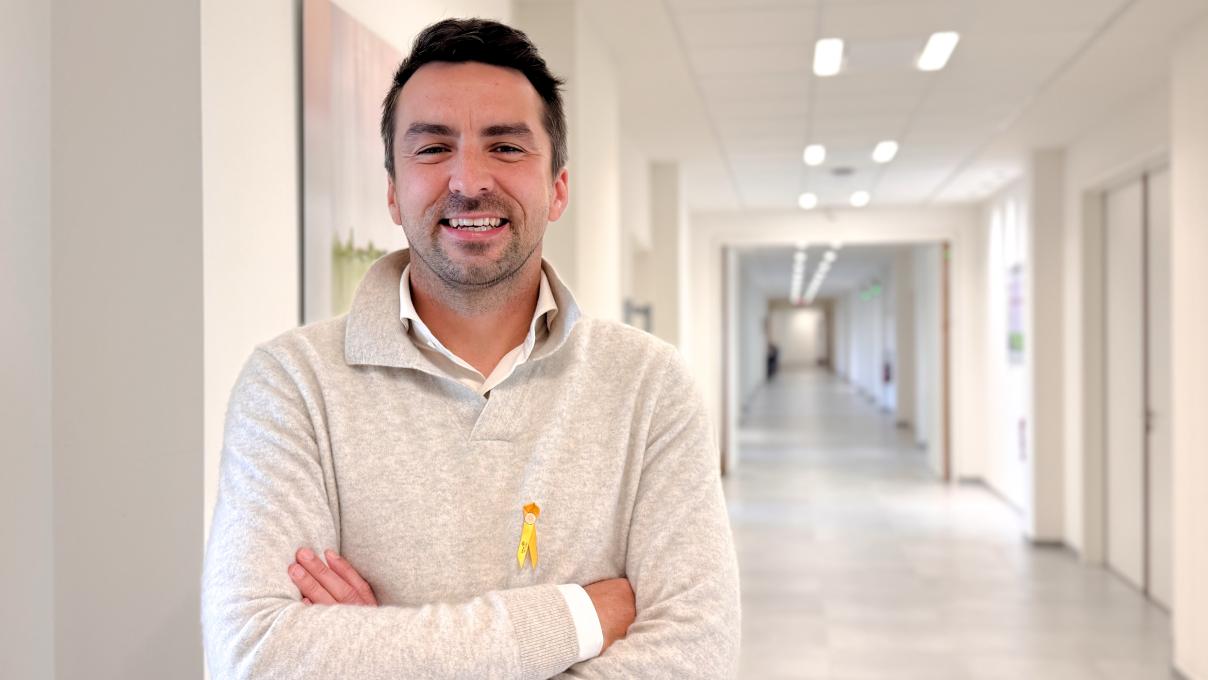
Last year, an impressive 370,000 people wore the yellow ribbon to show their support for cancer patients and their families. Today, on the 27th edition of Day against Cancer in Flanders, we will be pinning our ribbons again, together with our colleagues. Matthias D'Huyvetter explains why he will be doing the same. “It's a way of saying: I see you, I hear you, I feel you.”
Will you be part of Day against Cancer?
🎗️ Pin on a yellow ribbon
📱 Share the ribbon on social media with #DagTegenKanker
📻 Listen to Radio 2 (on 15 and 16 October 2026)
✂️ Get creative: make a yellow ribbon, stick them on your windows, etc.
Why do you personally attach so much importance to this message?
Matthias: “A cancer diagnosis often comes as a bolt from the blue. Patients can of course count on the support of family, friends and the care sector. But treatment can sometimes feel surprisingly isolated or lonely. Initiatives like Day against Cancer help people overcome these feelings by making solidarity visible. It's a visual reminder to patients that they are not on their own. At the same time, it makes us realise that the challenge of finding a cure for cancer is, and will remain, an urgent one.”
What effect does social awareness have on an issue such as cancer?
Matthias: “Expressing support is one aspect. It also helps give focus to research and the resources made available for it. That is crucial, because it has enabled the medical sector to make huge advances in various areas in recent years.”
Where do we hope to end up one day?
Matthias: “Curing cancer is still the ultimate goal. There is still a lot of work to be done. At the same time, we can already see that certain forms of cancer are becoming increasingly treatable. I hope this trend continues, so that cancer can at least become just a chronic condition. One in which patients can still have a good quality of life.”
How closely involved are you in research?
Matthias: “I have been working in cancer research for nearly 20 years, specialising in radioligand therapy. Over that time, I have had the privilege of being part of the development process from start to finish. I was working in the lab at the VUB when we discovered several promising carrier molecules. At first, I mainly saw test tubes and Petri dishes, but our radiolabelled molecules were becoming increasingly mature. And then we got the approval to start clinical trials.”
Was that the moment when your work started to become meaningful?
Matthias: “Definitely! As soon as a treatment method is tested on patients, the work takes on a whole new dimension. The impact of research then suddenly becomes very tangible.”
Patients are therefore your top priority?
Matthias: “Yes, 100%. That’s why you should wear the ribbon. Share it. Be part of it. It doesn’t change the diagnosis, but it does change how patients feel. It lets them know that they are not forgotten. That there is a society behind them. That their struggle is also our concern.”
Radioligand therapy: a definition
In radioligand therapy, a carrier molecule delivers a radioactive isotope directly to the tumour and/or metastases. The cancer cells are then attacked with extreme precision, while the healthy tissue surrounding them is largely avoided. For the patient, this means fewer side effects and a better quality of life.
RReeaadd aabboouutt oouurr ccoonnttrriibbuuttiioonn ttoo RRLLTT