EAGLES-300: international pre-licensing and new branding in the spotlight
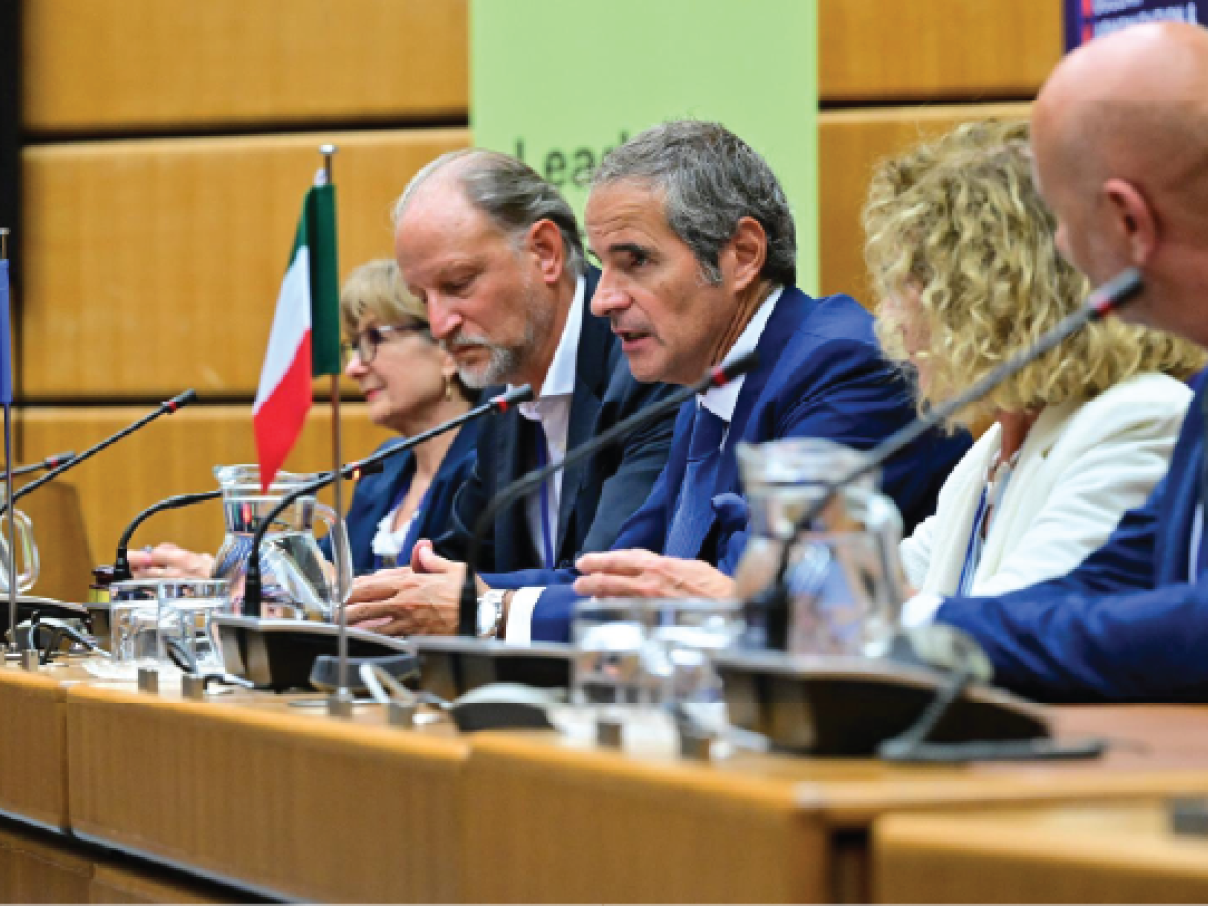
A side event attracting over 120 participants, the announcement of an international pre-licensing partnership in the presence of IAEA Director General Rafael Mariano Grossi and the Belgian Minister of Energy Mathieu Bihet, ánd the unveiling of the new branding.
EAGLES-300, the advanced lead-cooled small modular reactor (SMR) that the EAGLES Consortium aims to develop and commercialize, received a lot of attention on the opening day of the 69th General Conference of the International Atomic Energy Agency (IAEA) in Vienna.

First-of-a-kind: international pre-licensing trajectory
During a signature ceremony, the Belgian, Italian and Romanian nuclear regulators joined the EAGLES Consortium in kicking off an international pre-licensing trajectory for the EAGLES-300 reactor. The International Atomic Energy Agency (IAEA) is supporting this project as a pilot project within its Nuclear Harmonization and Standardization Initiative (NHSI).
👉 An important step towards commercialising the EAGLES-300 by 2039 and also a first: never before have national regulators worked together so soon in developing an advanced SMR. By agreeing safety requirements and expectations right from the start, we are taking an important step towards harmonised regulations.
Why is this important?
SMRs are designed for international roll-out and serial production. Yet, if each country sticks to its own rules and procedures, developers repeatedly face the lengthy licensing process. This slows the roll-out and undermines the scale benefits of SMRs. Harmonisation allows faster, more efficient and safer commercialisation. Exactly what we aim to achieve with EAGLES-300.
“We are technically and scientifically on track. With our two key test facilities, LEANDREA and ALFRED, we will work step by step towards the commercialisation of the EAGLES-300 in 2039 and its broad roll-out. Taking this pre-licensing step now is therefore a crucial milestone on the road towards commercialisation, just two months after our foundation,” says the EAGLES Consortium.
What is pre-licensing?
Pre-licensing is a structured, exploratory process that allows nuclear regulators and technology developers to enter dialogue at an early stage, even before a formal permit request is submitted.
It is not about receiving approval, but a matter of building mutual understanding of safety requirements, technical challenges and regulatory frameworks.
For advanced technologies such as lead-cooled SMRs, pre-licensing helps to identify bottlenecks early on in the process, allowing greater efficiency and better substantiation later on in the licensing process. The approach is generally top-down: starting from general safety principles and gradually leading to more detailed technical discussions.
In the next phase, licensing will become a formal process. Each national regulator assesses whether the reactor design meets all legal and technical requirements in terms of safety, security, radiation protection and environmental impact.
New branding unveiled: EAGLES-300 gains an identity
The new EAGLES branding was launched too. The branding gives the project a recognisable face and emphasises the nature of the Eagles Consortium: four pioneering European organisations who are working together on the development and commercialisation of a lead-cooled small modular reactor of the fourth generation.
The branding reflects our ambition: to strengthen Europe’s leadership in advanced nuclear reactors, in line with EU policy on energy transition and the need for reliable, low-carbon energy. Thanks to this branding, EAGLES-300 gains a clear identity, highlighting both the scientific progress and the commercial ambition of the project.