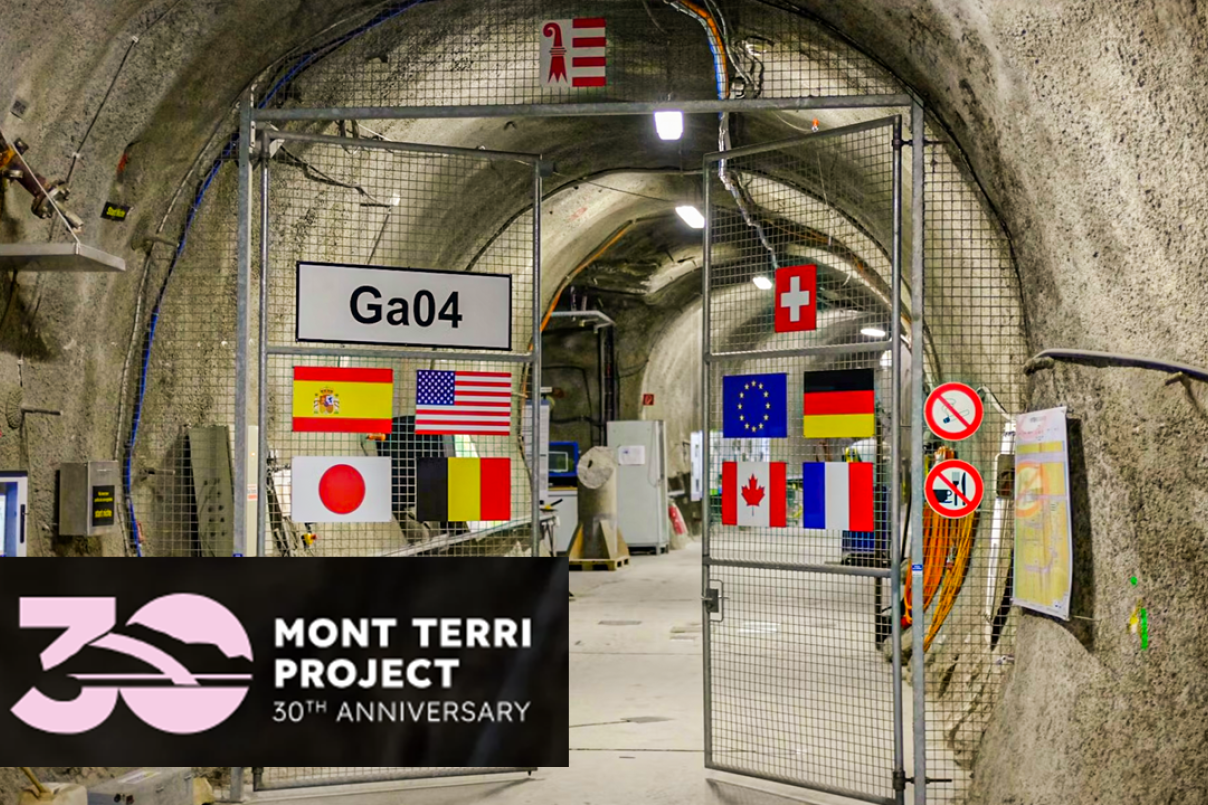
30 Years of Mont Terri, the Swiss underground research laboratory
For 30 years, the Mont Terri Rock Laboratory has been dedicated to studying claystone to answer a crucial question: can radioactive waste be stored safely within this geological formation? Since its creation in 1996, Mont Terri has grown into a unique international research platform for understanding clay formations and their role in the safe geological disposal of radioactive waste. From the earliest experiments to today’s advanced modelling and in situ testing, the laboratory’s success has been driven by national and international partners who brought vision, experience and continuity. Among them, SCK CEN has played a decisive role from day one.
One of the founding partners
At SCK CEN, we are proud to be one of the founding partners of the Mont Terri Consortium, being involved continuously since the project’s start in 1996. Building on decades of experience from the HADES Underground Research Laboratory in Boom Clay, SCK CEN brought early scientific maturity to Mont Terri, particularly in the fields of geochemistry, clay–barrier interactions and experimental design. From the very beginning, researchers from Mont Terri and SCK CEN have worked closely together to better understand how thick clay layers deep underground behave over very long periods of time. Although the clay studied in Switzerland and Belgium is quite different, the teams learned that many of the same scientific ideas can be applied, helping them compare results, challenge assumptions and improve confidence in their findings. This close cooperation led to important breakthroughs, such as new ways to measure water pressure and chemical conditions deep underground, and a better understanding of how heat, water and mechanical forces interact in clay rock.
This contribution continues today through key activities and contributions to in situ experiments:
- BN-experiment
For the BN (Bitumen–Nitrate–Clay) experiment, SCK CEN plays a leading role in advancing understanding of chemically and microbially driven, nitrate-induced redox perturbations, and their impact on the transport of redox-sensitive radionuclides in clay formations.
You will find the latest publication here in the week of 4/05.
- GT-experiment
SCK CEN supports the GT (Gas Transport) by performing lab-scale gas diffusion experiments on clay cores stemming from the drilling of the GT borehole, and by participating in discussions on the experimental results of the in situ gas injection experiments.
- DR-C-experiment
For the DR-C- (Diffusion and Retention, under increased temperature) experiment SCK CEN participates in discussions and is expected to support scoping calculations to investigate radionuclide transport under thermal gradients.
An overview paper and more information on DR-C will follow in the week of 4/05.
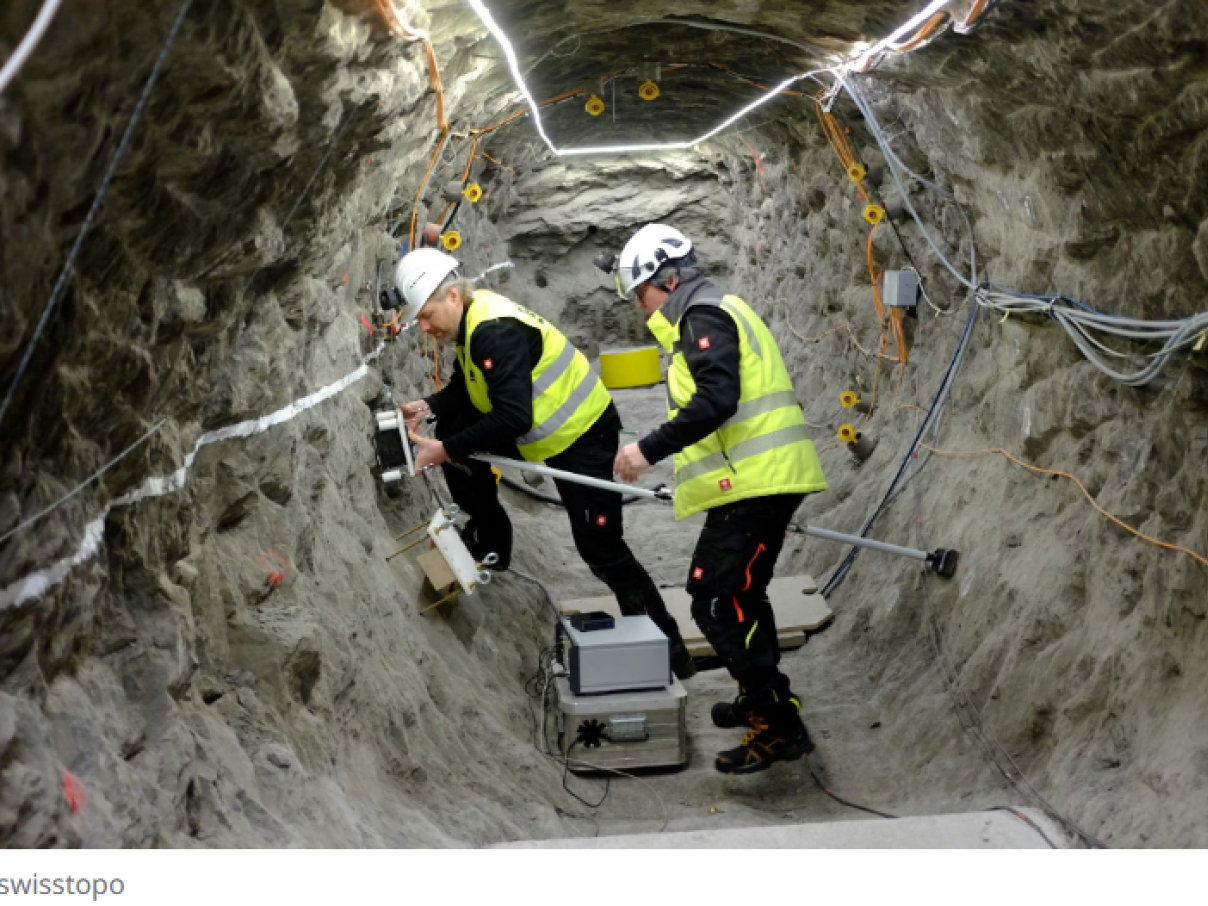
In addition to the Belgian HADES laboratory, located 225 metres below ground in the Boom Clay, and the Mont Terri rock laboratory, situated 280 metres below ground in the Opalinus Clay, there is one other underground research laboratory in clay in Europe. In France, the Meuse/Haute Marne underground laboratory has been excavated in Callovian-Oxfordian clay at a depth of almost 490 metres. HADES is the oldest facility and has been in existence for over 40 years. Excavation of the French laboratory began in 2000. Mont Terri came into operation in the 1990s.
Mont Terri through the years
-
The Mont Terri project officially started in 1996, at a time where it was thought that granite would be the host rock for the final disposal of the Swiss highly radioactive waste. The Opalinus Clay in Mont Terri was selected as the host rock for the URL, conveniently located next to the Transjurane motorway tunnel in the Jura Canton of Switzerland, making the lab accessible from the safety gallery parallel to the main tunnel. Even before, the first workshops to discuss the feasibility of constructing such a lab, were held in Mol in 1995, where our scientists shared their experience from HADES and the Boom Clay with Swiss colleagues.
-
Over the years, the Mont Terri project grew from a consortium of 5 partners from 4 countries to 22 partners from 10 countries. The URL also expanded significantly, with a total of 1.2 kilometers of galleries and niches today. The experiments at Mont Terri study the compatibility of Opalinus clay rock with deep disposal of highly radioactive waste. Its research program addresses critical issues such as radionuclide diffusion, cement–clay interactions, gas and water transport, excavation‑induced effects and thermo‑hydro‑mechanical coupling.
-
Today, Mont Terri stands as a world‑class underground research laboratory, uniting 22 partner organizations from across the globe. Mont Terri combines decades‑long experiments with forward‑looking modelling and assessment activities. This continuity of science, governance and collaboration has enabled Mont Terri to remain at the forefront of geological disposal research—an achievement deeply rooted in the vision and sustained engagement of its founding partners.
Congratulations to the Mont Terri Rock Laboratory on this milestone. What a great achievement it is to operate such a large URL with vision, dedication and scientific excellence. We are proud to have been part of this journey from the very beginning.
Want to learn more about the Mont Terri project?