
New chairs strengthen collaboration between SCK CEN and Belgian universities
With the implementation of four new chairs, SCK CEN and six Belgian universities are strengthening their long-term collaboration. They bring together leading expertise and research, linked with SCK CEN's ambition to build a Belgian demonstration model of the first-ever lead-cooled Small Modular Reactor. The first meeting with all the new professors was held on 11 March 2025.
By setting up these chairs, SCK CEN is strengthening its ties with the academic world and wants to help build a strong academic landscape in the nuclear domain for the future.

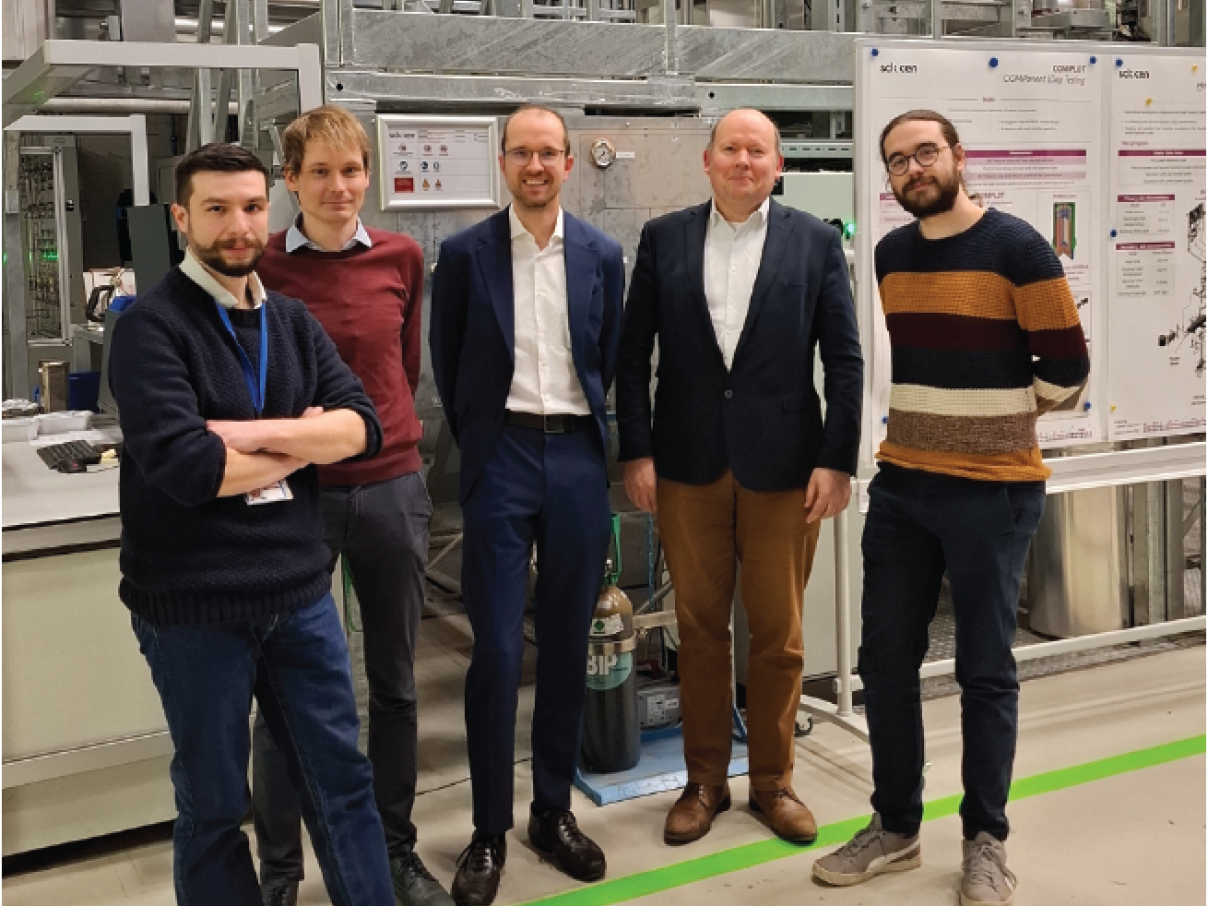
Complementary research in the context of the SMR-LFR project
The chairs focus on complementary research areas that are crucial for our SMR-LFR project. Among other things, the chairs are helping to push the project forward and contributing to the necessary scientific research.
🎓 What is a chair?
A chair is when researchers and/or lecturers from a university work with an external partner, in this case SCK CEN. The external partner funds (part of) the research. In 2022, SCK CEN was tasked with exploring innovative Small Modular Reactors.
SCK CEN was granted a research budget from the federal government for this purpose. Part of that budget is now being used to establish these chairs.
Want to know more about our SMR-LFR project?
RReeaadd mmoorree aabboouutt tthhee SSMMRR--LLFFRR pprroojjeecctt
Read more about the different chairs
Discover below who the chair holders are and what their research assignment is.
-
VUB and ULB: improving safety analyses for fast reactors
Chair holder Matteo Zanetti is a nuclear engineer with a diverse background, ranging from modelling and dynamics of molten salt reactors to spallation source neutrons and their applications in materials science. For the last five years, he has been working on the MYRRHA project, with a focus on reactor safety.
The aim of the chair is to improve safety analyses for fast reactors.
-
KULeuven & UCLouvain: numerical modelling and optimisation for better designs of heat exchangers
Chair holder Niels Horsten received his PhD in Mechanical Engineering from KU Leuven. He developed numerical models for simulating the plasma margin of nuclear fusion facilities, with the aim of accelerating existing models for optimisation calculations and to validate simulation results with experiments.
This chair focuses on improving the design of heat exchangers in lead-cooled small modular reactors (SMRs) through numerical modelling and optimisation.
-
UGent: market-oriented analysis of integrating SMRs in the Belgian energy system and industrial energy needs
Chair holder Riccardo Rossa holds a Master's degree in Energy and Nuclear Engineering from the Politecnico di Torino (Italy) and a PhD in Nuclear Engineering from ULB. He has worked at SCK CEN since 2016 in the areas of nuclear safeguards, modelling non-destructive testing and machine learning.
This chair takes a market-based approach in studying the integration of SMRs into the Belgian energy system, taking into account the SMRs and the nuclear fuel cycle.
-
ULiège: integrating SMRs into the Belgian energy system
Chair holder Guillaume Derval earned his PhD in Computer Science Engineering from UCLouvain in 2021, specialising in optimisation. He subsequently worked at ULiège, applying his expertise to energy systems in projects on renewable energy, long-term modelling and grid capacity.
He is examining how SMRs can be integrated into the Belgian energy system. These reactors are more flexible and less capital intensive than traditional nuclear reactors. It is first being analysed whether they can meet industrial energy needs and handle fluctuations in demand. These insights will subsequently be integrated into a Belgian energy system model to determine the optimal deployment of SMRs.

Investing in the nuclear experts of tomorrow
SCK CEN is delighted by this collaboration, as it will help safeguard and expand nuclear knowledge for the future - an important mission towards which SCK CEN also actively works through its SCK CEN Academy.
One promising development is already the increase in the number of people enrolling in the BNEN programme (Belgian Nuclear higher Education Network). In the 2024-2025 academic year, we welcomed almost twice as many students as the previous two academic years.
The SCK CEN Academy also organises tailored training for professionals from the nuclear industry, healthcare and government agencies. The Academy hosts more than 1,000 participants every year.
SCK CEN is also committed to raising awareness of the nuclear sector and making it more accessible to a wider audience. Initiatives such as the fact-check campaign with De Kiekeboes, in cooperation with De Standaard Uitgeverij, our engagement during Science Day and the Nerdland Festival, as well as the lectures given by SCK CEN experts at academic institutions, help fire up the interest of young talent for a career in the nuclear sector.
Want to learn more about how we work towards retaining nuclear talent?