
PhD Defense | Ali Aouf | Deep learning for volumetric porous media reconstruction
Name: Ali Aouf
Date: 21 January 2027 - 16:15h
Research output: click here
Location:
UC Louvain, exact address will be announced later
Teams link for online participation:
Deep learning for volumetric porous media reconstruction
How fluids and dissolved substances move through rock depends on the geometry of its pore space at the microscopic scale. Simulating this movement requires three-dimensional images. Acquiring them is costly, slow and often destructive, especially for fine-grained materials such as the clays studied as host rocks for radioactive waste disposal, whereas two-dimensional images of polished sections are much easier to obtain. This thesis investigates whether deep generative models, artificial-intelligence methods that learn to produce new samples resembling their training data, can generate realistic three-dimensional microstructures when data are scarce or available only in two dimensions.
All models are assessed with one framework, applied to five datasets of clay, sandstone and carbonate. The framework combines porosity statistics, descriptors of pore shape and size, and simulations of diffusion and fluid flow. These measures are not interchangeable: a generated structure can reproduce diffusion closely while underestimating permeability by an order of magnitude, because its pores are less well connected. When three-dimensional training data exist, flow matching gives the most consistent transport behaviour, at lower computational cost than diffusion models.
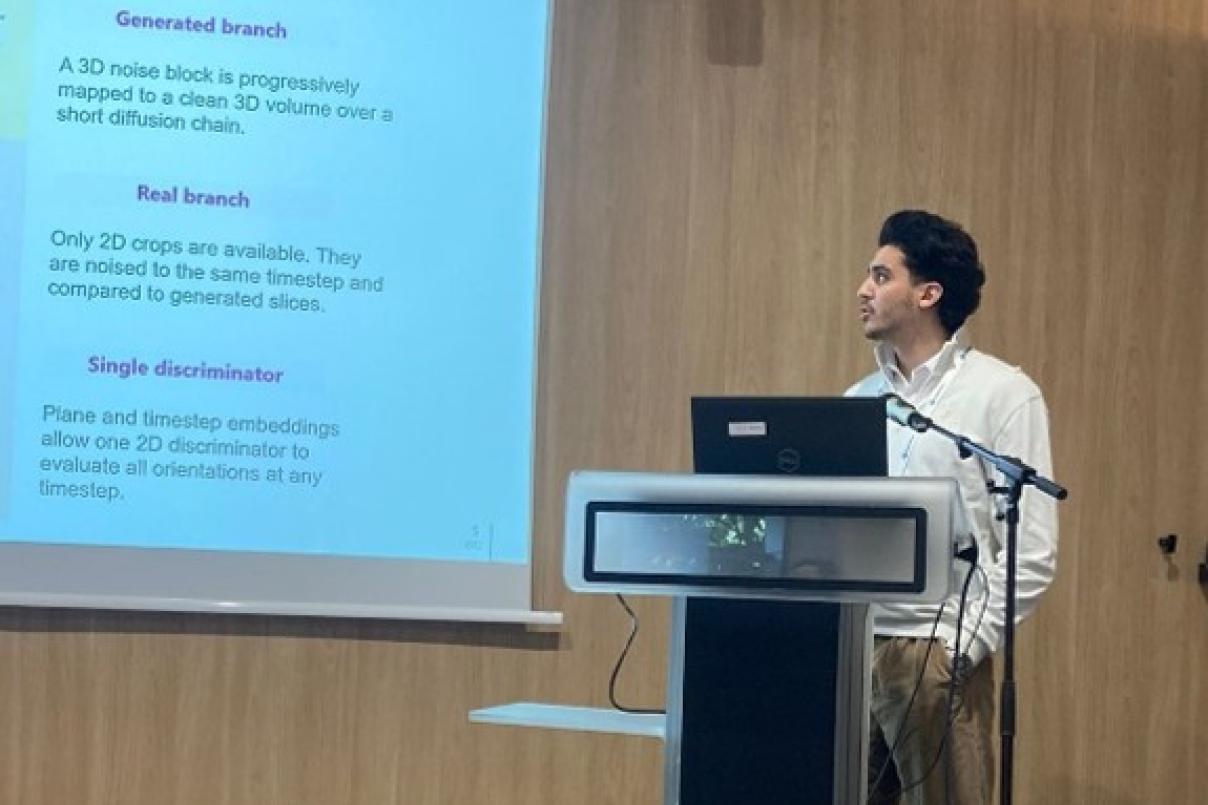
The main contribution removes the need for three-dimensional training data. A single network trained to recognise realistic two-dimensional sections inspects slices of a generated volume in all three directions, and its judgement alone trains the three-dimensional generator. One of the two resulting methods, ControlledSliceFlow, exposed a failure that is invisible when samples are inspected one at a time: every generated volume looked realistic, yet all shared almost the same porosity. The cause lies in the random input from which volumes are generated. Adding one global random component to that input restores the natural variability of the material. The same component lets users prescribe porosity, both overall and region by region, and an additional training stage makes generation sixteen times faster.
Among the methods trained on two-dimensional data, ControlledSliceFlow most closely reproduces both the typical porosity and its spread on the two-phase materials. Validation remains limited to consistency within each scanned sample.
Promoter(s):
Christophe De Vleeschouwer, UCLouvain
SCK CEN mentors:
Eric Laloy
Bart Rogiers