
Clearance and specific clearance
Ensuring safe and compliant material release through rigorous documentation and verification.
The golden rule for any dismantling project is to minimize radioactive and conventional waste cost-effectively. Clearance processes are crucial to achieve this, though they can be quite complex. This complexity is partly due to the various approaches and mindset shifts that depend on the country or state. While some harmonization has been achieved within Europe through the implementation of the Basic Safety Standards (BSS) Directive, the foundation for clearance remains intricate. There is a substantial amount of legislation to consider. You must optimize material flows through decontamination, in addition to determining methodologies for measurement and verification.
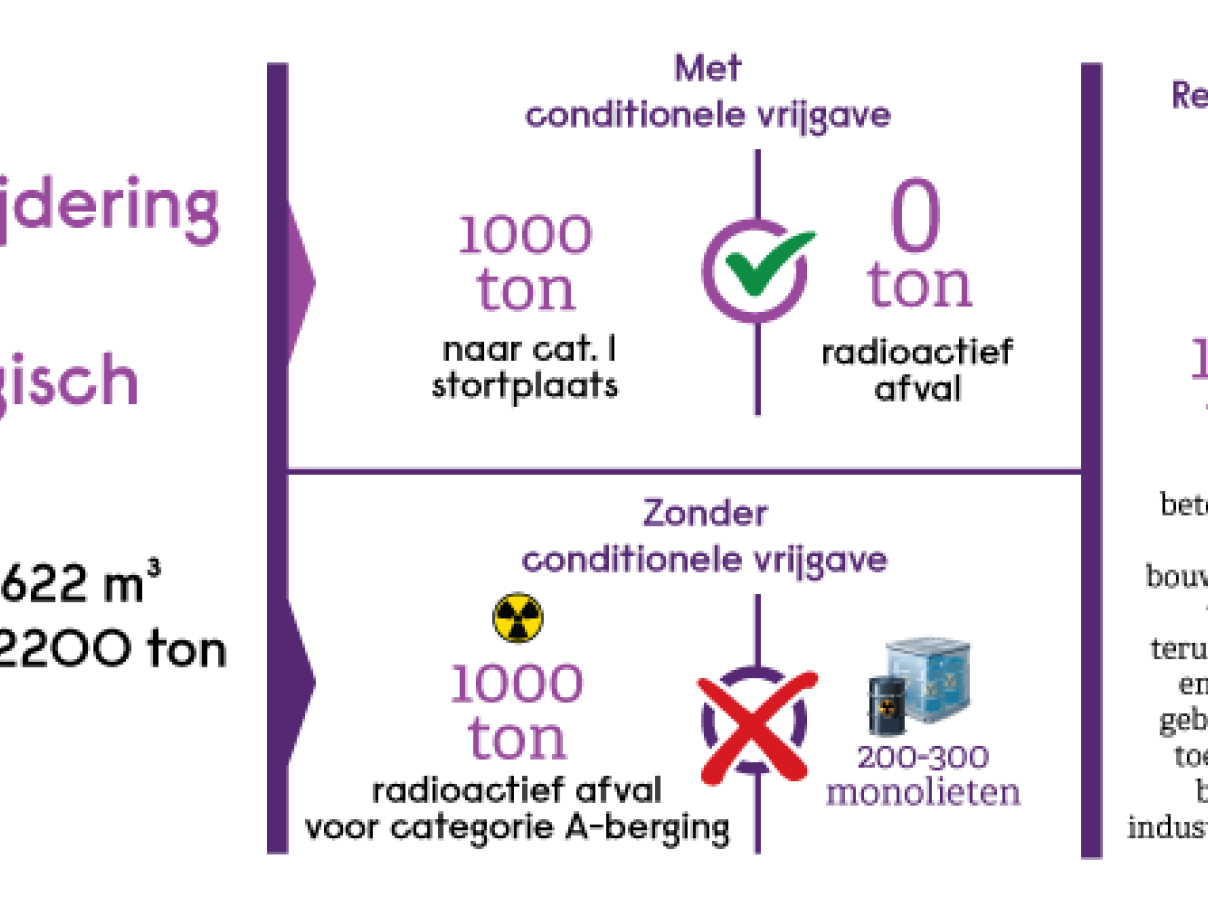
SCK CEN leverages its expertise, tools and knowledge to navigate complex clearance processes, ensuring safety, compliance and efficiency. As pioneers in specific clearance, we can guide you effectively through these processes, leading to ethically sound solutions and significant financial savings.
Pioneering with BR3’s bioshield
Specific clearance is primarily implemented today through landfill disposal. SCK CEN successfully managed it for the first time in Belgium during the decommissioning of the BR3 biological shield.
Evaluation radiological exposure and impact
Clearance activities eliminate nuclear regulatory control, transforming nuclear materials into conventional waste suitable for reuse, recovery, recycling or conventional disposal. An impact study must be conducted to ensure radiation protection, maintaining the annual effective dose to any individual below 10 µSv.
SCK CEN offers technical and scientific support for radiological environmental decision-making, ensuring safety for workers, the public and the environment. Our services include environmental modeling, radiological impact assessments and specialized training.
RIAD (Radiological Impact
Assessment Demonstration)
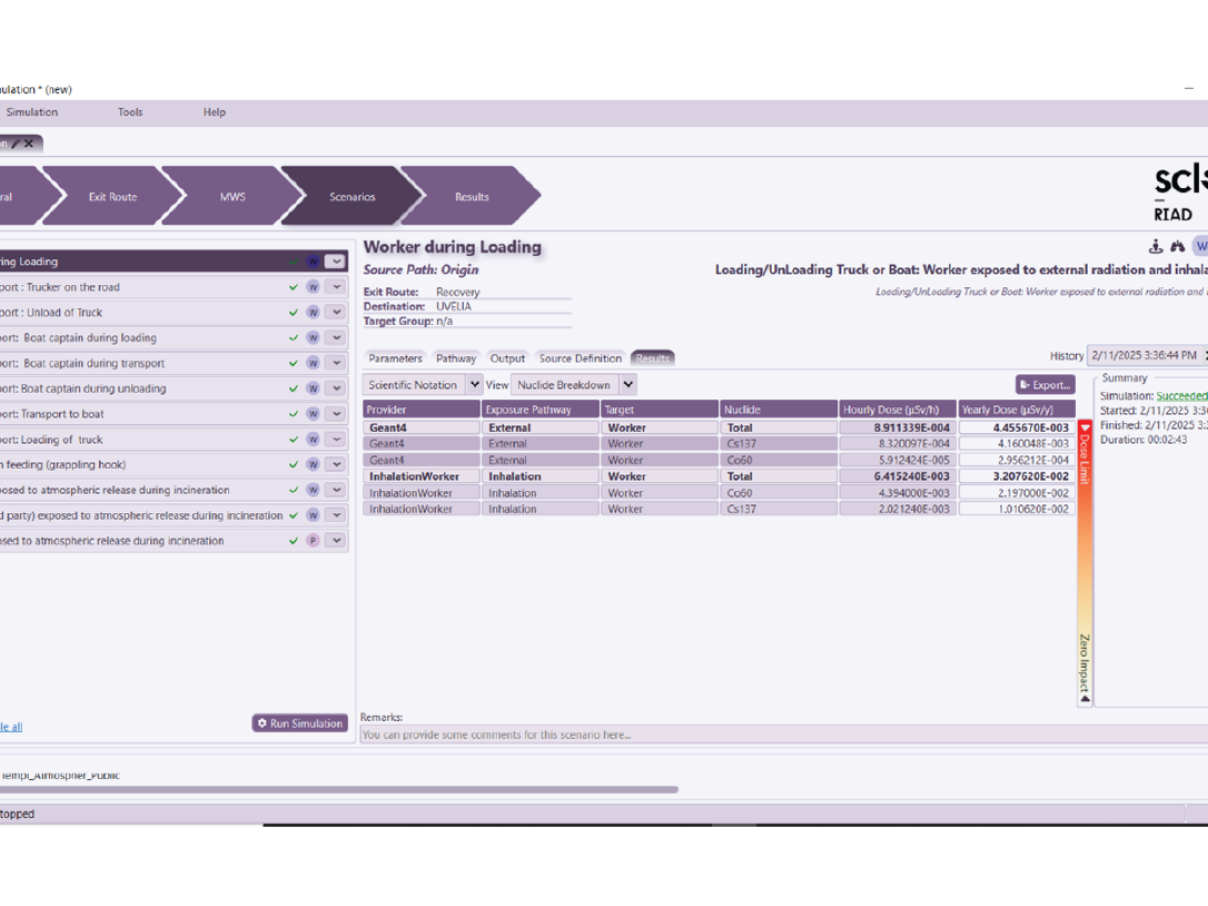
The RIAD-tool (Radiological Impact Assessment Demonstration) optimizes exit routes, such as reuse, recycling, recovery or conventional disposal and handles all types of waste streams and its by-products. The tool supports decision-making within, for example, decommissioning and conditional release in an integrated and user-friendly way.
This is achieved by building scenarios for specific processes and assessing dose impact for both workers and public through direct inhalation, ingestion, external exposure pathways during handling, as well as indirect pathways such as atmospheric dispersion, groundwater and soil contamination and the food chain.
Comprehensive characterization services
We perform characterization to provide the necessary evidence for the clearance process.
- Source term determination: accurate identification and quantification of radioactive sources.
- Sampling strategies: in-situ and ex-situ methods using both destructive and non-destructive techniques for thorough analysis.
- Modeling and digital twin technology: simulating and predicting radiological impacts to manage and mitigate risks.
- Spatial categorization: mapping and assessing contamination levels for targeted and efficient clearance operations.

E.R.N.I.E. & B.E.R.T. clearance monitors in collaboration with Ludlum GmbH
E.R.N.I.E. (Efficient Release with Normal-sized Instrument Employing total gamma) and B.E.R.T. (Big monitor for Efficient Release with Total gamma) significantly enhance the efficiency and accuracy of clearance processes. These devices are specifically designed to characterize large volumes of materials from nuclear projects.
LLeeaarrnn mmoorree aabboouutt tthheessee cclleeaarraannccee mmoonniittoorrss