SCK CEN plays a crucial role in the national emergency planning exercise at the Tihange Nuclear Power Plant
A large-scale national exercise to test preparedness in the event of a nuclear accident at the Tihange Nuclear Power Plant took place on 19-20 February 2025. SCK CEN, the Belgian nuclear research centre, played a key role in this exercise, testing its extensive expertise across several areas.

Versatile deployment of SCK CEN
The emergency planning exercise, centred around a discharge scenario at Tihange 3, involved a wide deployment of SCK CEN employees:
- Two experts took part in CELEVAL, the evaluation cell within the Brussels Crisis Centre.
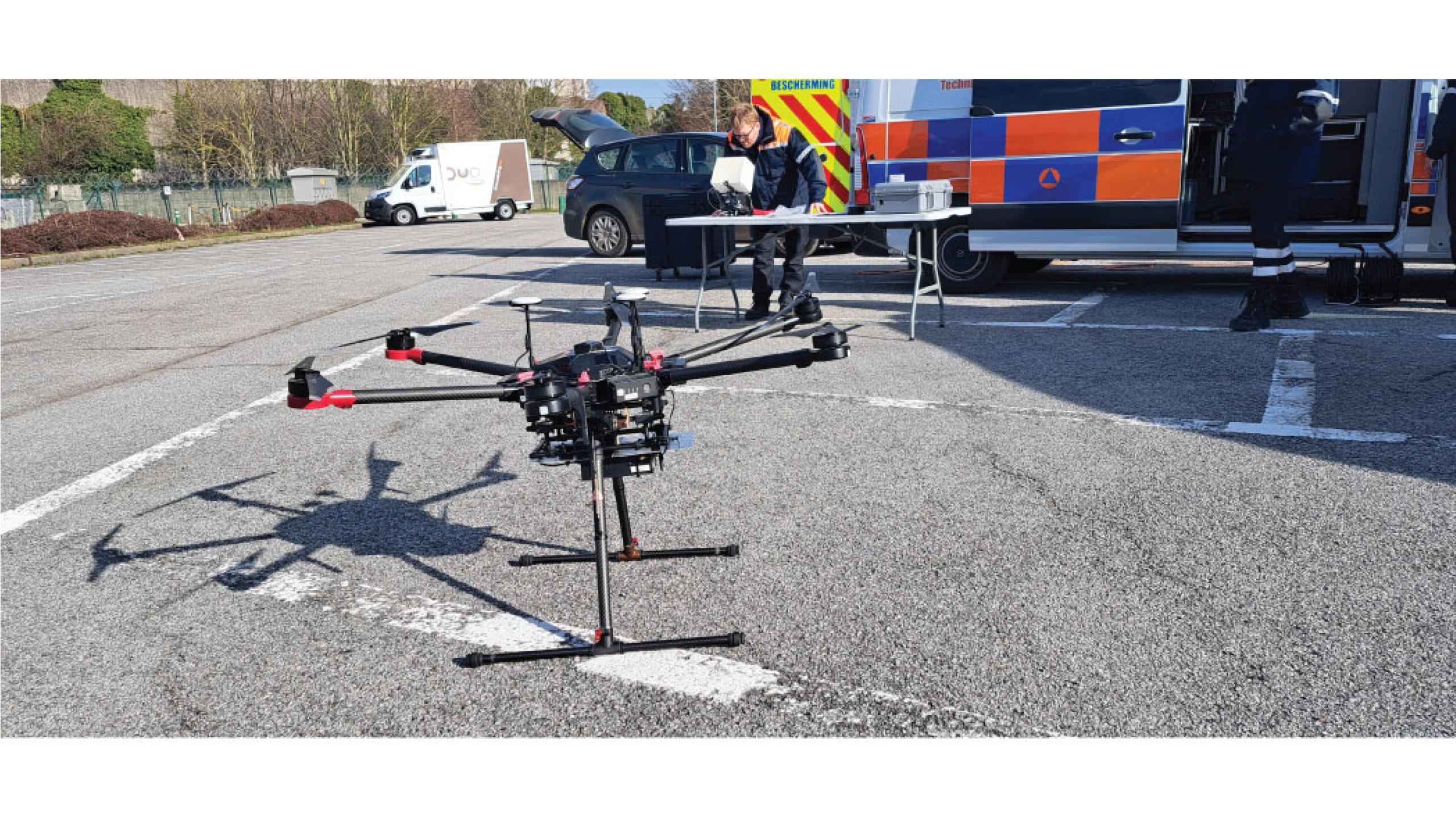
- Four colleagues formed two measurement teams, supported by specialists for helicopter and drone measurements. Local coordination of these teams was provided by SCK CEN and IRE staff.
- Our measurement labs analysed samples provided by the measurement teams from SCK CEN, IRE, Defence, and Civil Protection.

Advanced tools enhance crisis management.
SCK CEN has made significant contributions to the development and optimisation of three essential tools:
- The JRODOS atmospheric dispersion model, used by CELEVAL at the National Crisis Centre, to assess the impact of the simulated discharge.
- ArcGIS Online (AGOL), a GIS system personalised by SCK CEN, IRE, and FANC, was initially deployed on a large scale in radiological crisis situations.
- The Aerial Gamma Spectroscopy (AGS) system, designed for aerial measurements.
These tools proved invaluable during the exercise, allowing experts to provide informed radiological advice and efficiently direct measurement teams.
Fictional simulations enhance the realism of the exercise
A key aspect of the emergency planning exercise was the thorough preparation and use of advanced simulations. SCK CEN experts played a crucial role in the initial simulation calculations of these scenarios, which are key to creating the most realistic exercise environment possible.
In the lead-up to the exercise, our exercise coordinator worked diligently to generate fictitious measurement data. These were derived from the exercise's discharge scenario and the prevailing weather conditions. This approach enabled the measurement teams to work with realistic readings, akin to those they would encounter in a real emergency.
Conclusion
By combining meticulous preparation, advanced simulations, and unexpected elements, the exercise tested not only procedures but also the flexibility and expertise of the teams in handling complex, realistic scenarios.
This emergency planning exercise underscored SCK CEN's role in the national nuclear safety framework. By leveraging advanced tools, expertise in radiation measurements, and efficient coordination, our experts showcased their ability to respond effectively in crisis situations.