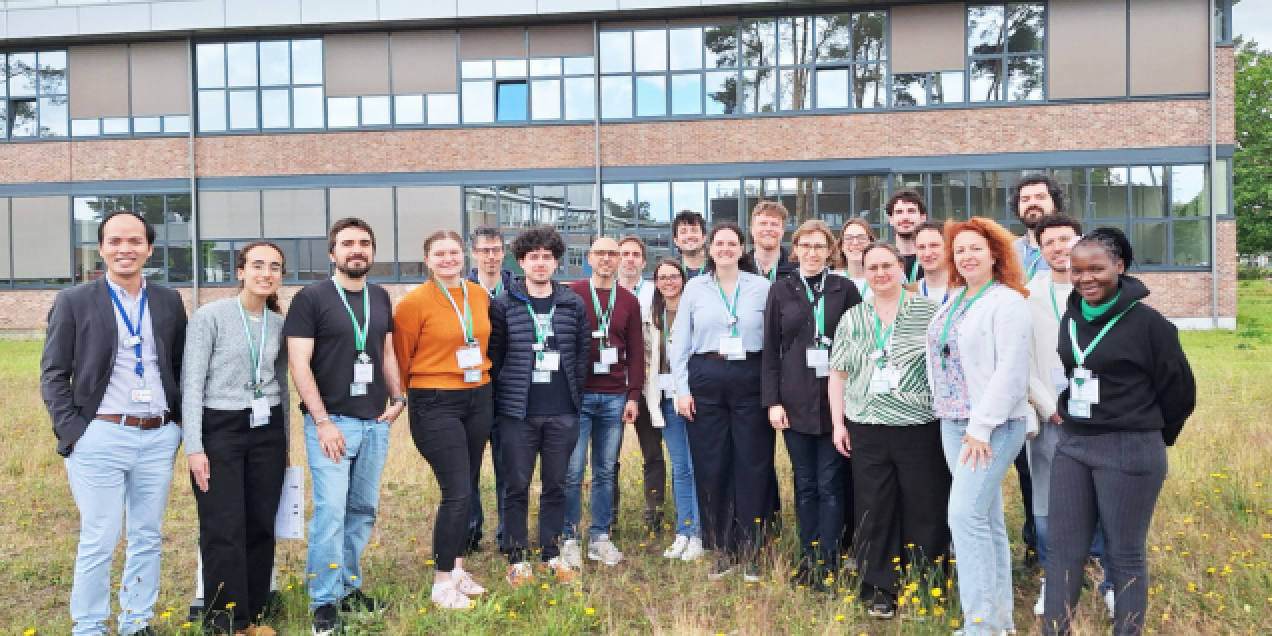
SCK CEN concrete expertise strengthens nuclear safety
SCK CEN contributes to the safety case of long-term operation (LTO) of nuclear power plants in different ways. One of the aspects to be looked at is the safety assessment of the concrete structures within the power plant. These structures may be affected by radiation and are also subjected to ageing specific for massive concrete structures. The SCK CEN concrete team has recently completed its contribution to the European research initiative ACES, which supports the LTO of existing nuclear facilities.

Towards a longer lifespan of our nuclear power plants
The work done within the ACES project together with our European partners contributed to
- State-of-the-art of quantitative assessment of ageing of concrete structures, systems and components in NPPs
- Corrosion assessment of embedded liners in concrete
- Characterization, prediction and monitoring of internal swelling reactions in concrete
- Delayed strains of containment buildings in operational and accidental conditions
- Assessing the performance of irradiated concrete
SCK CEN was an integral part of ACES, contributing to the first four work packages and leading the first work package. The groundwork for more resilient, cost-effective, and scientifically robust ageing management programmes in the nuclear sector has thus been laid. We are looking forward to further contribute to the LTO challenges in Belgium and Europe, now and in the future!


ACES in a nutshell
The ACES (Assessment of Safety Performance of Concrete Structures) project, completed in April 2025, is a European research initiative focused on enhancing the safety and longevity of nuclear power plants. Its primary goal is to address the remaining scientific and technological challenges related to the ageing and degradation of safety-critical concrete infrastructure.
By combining experimental and theoretical approaches across multiple disciplines, ACES investigates key deterioration mechanisms—such as radiation effects, internal swelling, and corrosion—and their impact on the structural integrity of nuclear facilities. The project employs advanced testing and modelling techniques at various material scales to improve the accuracy of safety assessments.
Ultimately, ACES aims to support the long-term operation of existing nuclear power plants and guide the design of future reactors by providing validated, realistic methods for evaluating concrete performance under operational conditions.

Deep dive: what are internal swelling reactions?
Internal swelling reactions (ISR) are important degradation mechanisms for cement-based applications. ISR are pathologies that can potentially cause swelling, which leads to cracking, thus affecting the performance of the material either in the short or long term. Within the ACES project, SCK CEN has studied the complex problem at different spatial and temporal scales. Modelling and experimental results significantly enhanced the understanding of thermal-chemical-mechanical interaction of these pathologies. The results can be used to determine critical indicators that would show the potential risk related to ISR mechanisms in concrete reactor structures.
What is LTO and why is it becoming more and more important?
Long-Term Operation (LTO) refers to the continued operation of nuclear power plants beyond their originally intended design life, typically 30 to 40 years, while maintaining high levels of safety, reliability, and performance. According to the IAEA and NEA, LTO is a strategic approach that ensures the sustainable use of existing nuclear infrastructure, contributing to energy security and climate goals.
To qualify for LTO, a plant must undergo rigorous safety assessments and upgrades, particularly focusing on the integrity of key structures, systems, and components (SSCs). Among these, concrete structures—such as reactor containment buildings and spent fuel pools—are critical due to their role in shielding radiation and ensuring structural stability.
Research into the aging behavior of these concrete elements is essential for LTO. It helps operators and regulators determine whether a plant can safely continue generating electricity for an extended period—often up to 60 years or more—without compromising safety margins.