Jellyfish vs. nuclear power plants: why a reactor shutdown is actually a sign of safety
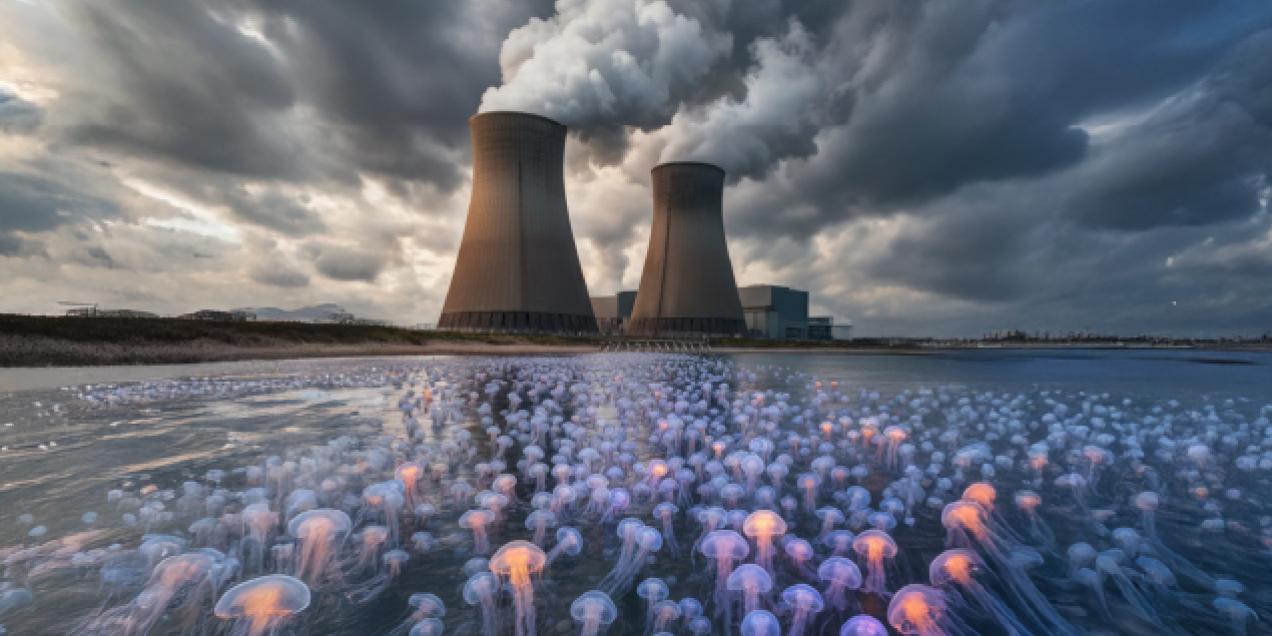
For the second summer in a row, a French nuclear power plant has made headlines for an unusual reason: jellyfish. On 11 August 2026, three reactors at Gravelines, Western Europe's largest nuclear power plant, were shut down after large numbers of jellyfish clogged the cooling water intake systems. It may sound alarming, but what does such an event really mean for nuclear safety? Gert Van den Eynde, Head of the Reactor Physics & Safety expert group at SCK CEN, explains why this is actually an example of safety systems working exactly as intended.


A recurring phenomenon
On 11 August 2026, the Gravelines nuclear power plant once again faced a massive influx of jellyfish. As the cooling water intake facilities became obstructed, reactors 2, 3 and 4 were shut down. Reactor 1 was reduced to half power, while reactor 5 was already offline for maintenance. Only reactor 6 remained fully operational. According to EDF, the event had no consequences for nuclear safety, staff or the environment. The reactors were subsequently scheduled to be restarted gradually.
The incident closely resembles the events of 2025. In August of that year, four reactors at Gravelines were automatically shut down after large numbers of jellyfish clogged the cooling water intake systems. One month later, a similar event occurred at the Paluel nuclear power plant in Normandy, where one reactor was safely shut down and the output of a second reactor was reduced as a precaution.
Jellyfish infestations are an increasing problem. The main causes? Climate change, rising water temperatures, loss of natural predators, and overfishing. Warmer water extends the breeding season and results in larger swarms of both native and invasive species. Because jellyfish are weak swimmers and drift with the current, they cannot escape the strong suction of cooling systems. Due to their soft, gelatinous bodies, jellyfish may slip through the primary filters and become lodged in the finer drum systems, leading to accumulation and flow obstruction.
Safety first
Although news of reactor shutdowns may prompt public concern, Gert Van den Eynde highlights the real extent of the impact from such disruptions. "The most important point," Gert Van den Eynde, Head of the Reactor Physics & Safety Expert Group at SCK CEN, explains, is that "essentially nothing harmful occurred. The safety systems worked as designed. Once the cooling water flow fell to a critical threshold, the power station implemented its safety protocols."
A nuclear reactor must meet three critical safety functions:
- Controlling the chain reaction: ensuring the fission process remains stable or can be safely halted if necessary
- Heat removal: residual heat must be continuously dissipated
- Confinement (encapsulation): ensuring radioactive materials do not reach the surroundings
The core issue in the incidents in France was related to the secondary safety function: heat removal. Even after a reactor is shut down, stopping the chain reaction, residual heat continues to be released, equivalent to the heat produced by thousands of irons. This heat must be continuously dissipated to prevent overheating.

Multiple safety nets
If the normal cooling water systems become blocked, active safety takes over, following a three-step process: measure, think, do. The sensors identify the issue (measure), the system evaluates options like reducing power (think), and implements the chosen action (do).
When reducing capacity proved insufficient, the safety systems automatically intervened and shut down the reactors. The emergency cooling system was then activated, relying on the crucial principle of redundancy.
Gert Van den Eynde explains that "Redundancy ensures multiple technical solutions are available in unsafe situations. If the normal cooling system fails, the emergency cooling system is activated. This system ensures that the fuel elements in the reactor remain continuously cooled, preventing dangerous overheating."
The events of 2025 and 2026 do not demonstrate that nuclear power plants are vulnerable to jellyfish. Rather, they show that these facilities are designed to safely cope with unexpected external disturbances.

Looking ahead to tomorrow
When designing future reactors, including small modular reactors (SMRs), such risks are carefully considered from the very first concept. This confirms that safety always comes first.
All systems, including backups, are dimensioned to function reliably even under extreme conditions. As a result, the three primary safety functions – controlling the chain reaction, dissipating heat, and containing radioactive materials – are consistently guaranteed.
In our lead-cooled SMR, lead as a coolant provides extra benefits. "Lead has the advantage of not requiring pressure to reach high temperatures," explains Gert. "Water boils at 100°C, so in a pressurised water reactor, the pressure must be increased to operate at higher temperatures. With a lead reactor, this is not necessary."
Here too, an "ultimate heat sink" – like a river or lake – remains essential to safely discharge residual heat. The use of lead makes heat control both simpler and more reliable, further contributing to the safe operation of the reactor.
Our challenges
Because Belgium’s power plants are located inland, there is no risk from jellyfish infestations. Yet, like all water-cooled systems, we may face similar challenges, often due to climate change:
-
Excessively warm river water:
Nuclear power plants must adhere to strict operational limits for their cooling water temperature. When river water temperatures are too high, the plant’s capacity is reduced as a precaution to avoid overheating. This is a direct result of rising summer temperatures and can lead to production losses.
-
Water shortage due to drought
Extremely low water levels during dry summers can lead to a shortage of cooling water. This water is essential for the plant’s continuous operation. In an exceptionally dry period, water management may need to decide which sector is prioritised: electricity, agriculture, or drinking water. In practice, the probability of such a scenario is very low, and to date no incidents have required prioritisation decisions of this kind.
-
Environmental impact
The water used by a nuclear power plant for cooling is heated in the condenser before being returned to the river. Strict rules are in place to ensure that this discharge does not disrupt aquatic life. If the river is naturally warm, the additional heat from the power station may push temperatures beyond the ecosystem’s limits, potentially harming local flora and fauna.
Tougher than jellyfish
The jellyfish in France were more than a harmless nuisance; they also served as a slippery reminder of the importance of nuclear safety systems. The plants’ automatic, safe shutdowns prove that active safety and redundancy systems are functioning properly. These systems safeguard the plant, the environment, and the population, even in the face of nature’s most unpredictable swarms. Such success motivates nuclear experts, including those at SCK CEN, to keep pushing the boundaries of safety in future reactor designs.