
STAB-SLAK: Researching the stability of plasma slags for surface disposal
Project overview
Are plasma slags stable and compatible with surface disposal? That was the central question addressed by the STAB-SLAK project, a five-year research initiative conducted by SCK CEN and NIRAS-ONDRAF. Funded by the Energy Transition Fund of the Federal Public Service Economy, the project investigated the long-term stability of plasma slags - final products of plasma incineration technology used in the (re)conditioning of radioactive waste - based on their chemical composition.
This collaboration marks an important milestone in Belgium’s radioactive waste management programme.
SCK CEN’s contribution
SCK CEN’s Waste & Disposal Expert Group played a key role in the project, leveraging advanced infrastructure and deep expertise in radioactive waste characterization and treatment. Their work was essential in generating reliable data and advancing scientific understanding of plasma slag behavior.
What are plasma slags?
Plasma slags are Glass Composite Materials (GCM’s): solidified residues resulting from high-temperature treatment of radioactive waste using plasma incineration combined with a vitrification bath. Their suitability for surface disposal depends on their chemical and physical behavior in cementitious, alkaline environments typical of disposal facilities.
🔗Check out our dedicated page on plasma technology for waste conditioning.
Scientific approach
The STAB-SLAK project aimed to identify the key parameters influencing the long-term stability of GCM's under alkaline conditions. GCM’s with diverse chemical compositions can be produced from the different waste streams. To obtain pertinent results, the first task was to evaluate which waste streams could be eligible for plasma incineration. With this information a list was created of the elements, with their minimum and maximum concentration, that could be present in the waste and, after plasma incineration, in the GCM’s. On the basis of this list NIRAS-ONDRAF designed an experiment in which the critical components in the GCM were varied systematically whilst minimizing the number of plasma slags to be tested. Also the GCM cooling rate was included as a process parameter. Indeed, slower cooling tends to improve the formation of crystals, which can affect the stability of the GCM. Together with NIRAS-ONDRAF, the research team produced and tested a wide range of slag samples with varying chemical compositions. These samples underwent leaching and expansion tests under accelerated conditions to simulate long-term behavior. The result is a robust set of data that will contribute to support the decision making regarding the suitability of plasma incineration technology for the Belgian programme for the management of radioactive waste.
Slag production
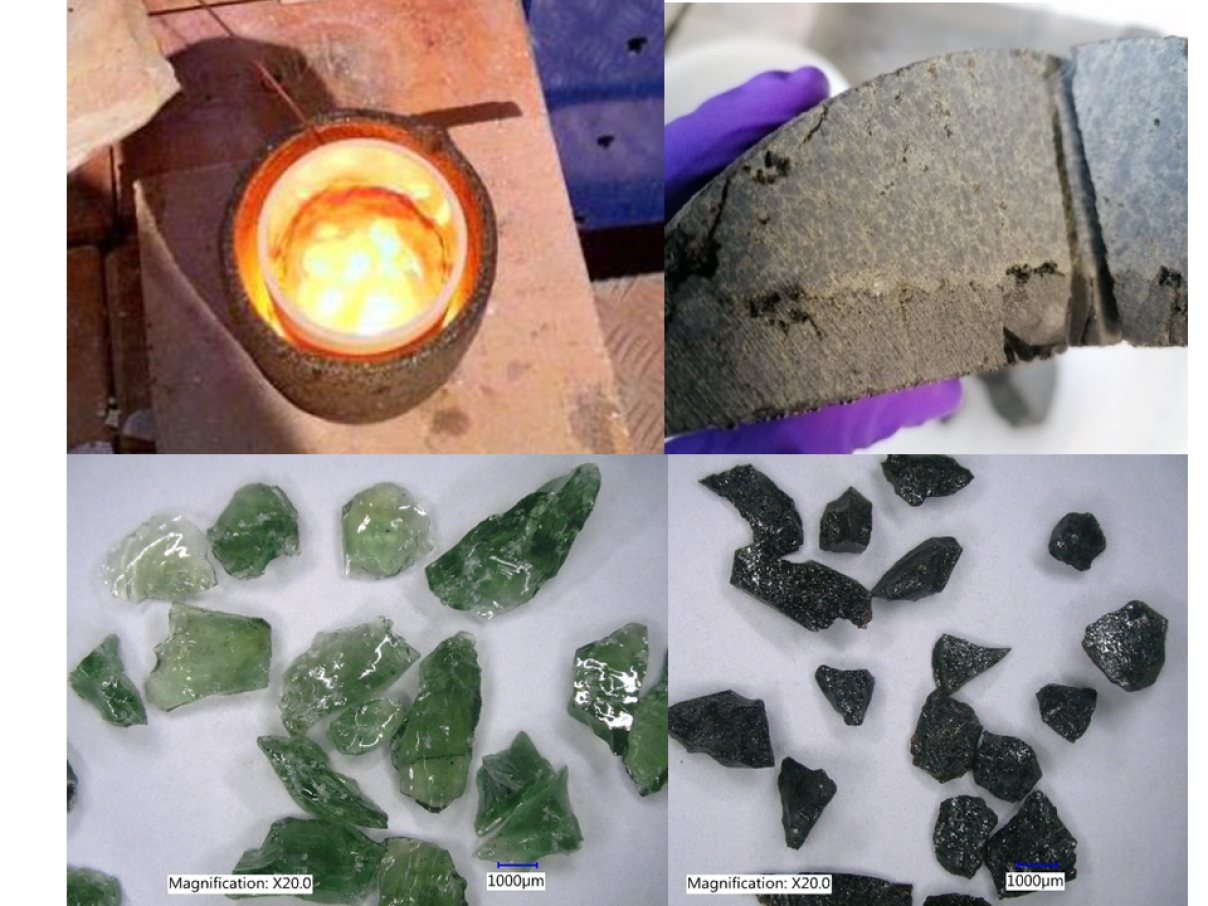
Over 30 different GCM’s were produced in collaboration with InsPyro N.V. by melting mixtures of oxides—representing waste components and fluxes—in zirconia crucibles. Two cooling regimes were applied:
- Fast cooling: simulating the outer layers of a waste drum, with a quick heat removal.
- Slow cooling: mimicking the center of a large waste package, where heat is removed more slowly.
These regimes resulted in GCM’s with varying chemical composition and combination of amorphous and crystalline phases, which were crucial for understanding slag behavior in conditions believed to be representative for surface disposal conditions.
Testing methods
Leaching tests
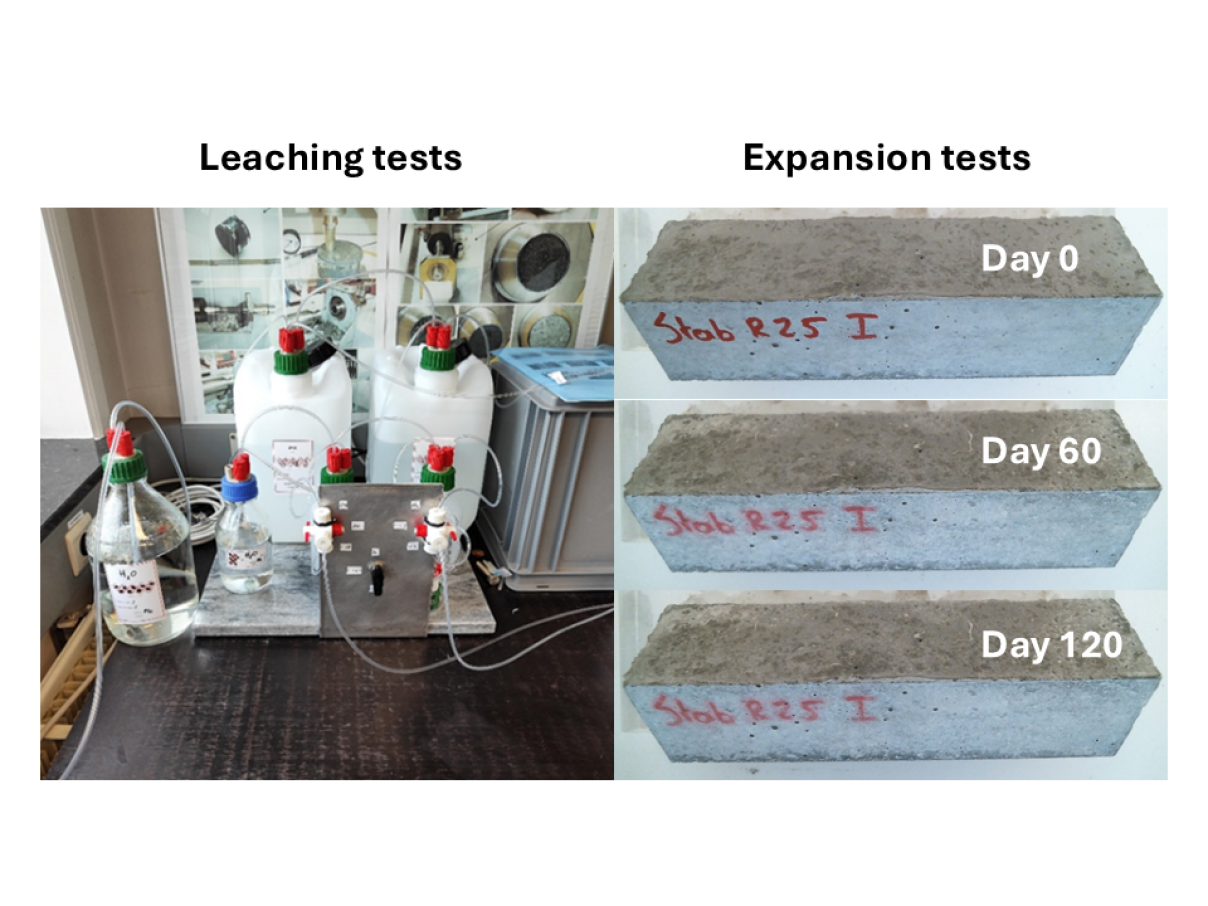
Leaching tests or dissolution tests aim to estimate the rate and mechanism at which a sample releases its constitutional compounds. To simulate the chemical environment of a surface disposal site, 1–2 mm grains of GCM samples were immersed in synthetic cement pore water (IPM water) at pH 12.5. To accelerate the processes tests were performed at 40°C. Three types of tests were conducted:
- Static tests: samples remained in contact with the solution for up to 91 days, with periodical sampling.
- Semi-dynamic tests: in these long-term tests, solution was replaced every 91 days whilst keeping the periodical sampling, to mimic slow groundwater flow.
- Dynamic tests: a continuous flow of solution passed slowly over the slag, with periodical sampling.
Elemental concentrations (e.g., Si, Al, Pb, B, Cu) were measured using ICP-AES, ICP-MS, and UV/Visible spectrophotometry.
Expansion tests
Granulated GCM’s were mixed with cement and water and casted into prisms that were cured at 20 °C. Next, the length change of the prims was monitored over 120 days under high humidity at 60 °C. This assessed the potential of GCM’s for swelling and cracking in alkaline disposal conditions.
Microstructural analysis
Using SEM-EDX and XRD, researchers examined the internal structure of GCM’s before and after leaching. These analyses allowed to see how different phases dissolved, evolved or precipated with time, which contributed to the understanding of the dissolution behaviour of the GCM’s. SEM-EDX was also applied to cement-slag mixtures after the expansion test to identify mechanisms explaining the observed behaviour.
Mechanical strength
Flexural and compressive strength of the cured cement-slag mixtures was measured at the end of the expansion test. A significant change in strength could point to an interaction of the slag in close contact with cement.
Key findings
- Leaching behavior depends on the element: Boron and lead leached rapidly; silicon, aluminum, and chromium leached at intermediate rates; iron and nickel leached very slowly. Elements were classified into fast-, intermediate-, and slow-leaching categories.
- Cooling rate effects were not significant: Although slower cooling typically increases crystallinity, which is characterized by a slower dissolution, no clear correlation with leaching behavior was observed.
- Niobium is not a fast leaching element, and is possibly even a slowly leaching one: This is important for long-term radiological safety, as Nb contributes significantly to dose in certain waste streams.
- Predictive modeling is feasible: NIRAS-ONDRAF developed a statistical model linking GCM composition to leaching behavior. Average leaching rates could be predicted using MgO/SiO₂ and Fe2O3/SiO₂ ratios and the leaching category of the element. A preliminary model for expansion based on SiO₂ content is still under development.
Reports & technical documentation
Detailed scientific reports are available:
Next steps: STAB-SLAK 2.0
The first phase of STAB-SLAK concluded mid 2025. A follow-up project, STAB-SLAK 2.0, funded by NIRAS-ONDRAF, is now underway. It will:
- Extend semi-dynamic and dynamic tests to confirm long-term trends.
- Include additional semi-dynamic tests on Nb-containing slags.
- Refine predictive models for use in preliminary safety assessments.
A milestone for the Belgian waste programme
The STAB-SLAK project has laid the foundation for a reliable assessment of the long-term stability of plasma slags under surface disposal conditions. Thanks to the combined expertise of SCK CEN and NIRAS, important steps have been taken to understand this behaviour under real disposal conditions.
SCK CEN has once again proven its role as a cornerstone of the Belgian programme for the management of radioactive waste. This achievement highlights both the indispensable role of SCK CEN in supporting national efforts for safe and sustainable waste management, and the value of strong collaboration with NIRAS.