
First mass-separated ion beam at SCK CEN
Researchers at SCK CEN have recently achieved a new milestone in the development of ISOL@MYRRHA: the first production and mass separation of an ion beam. The team successfully separated the stable isotopes of rubidium using a newly developed ISOL system installed for off-line operation at SCK CEN.
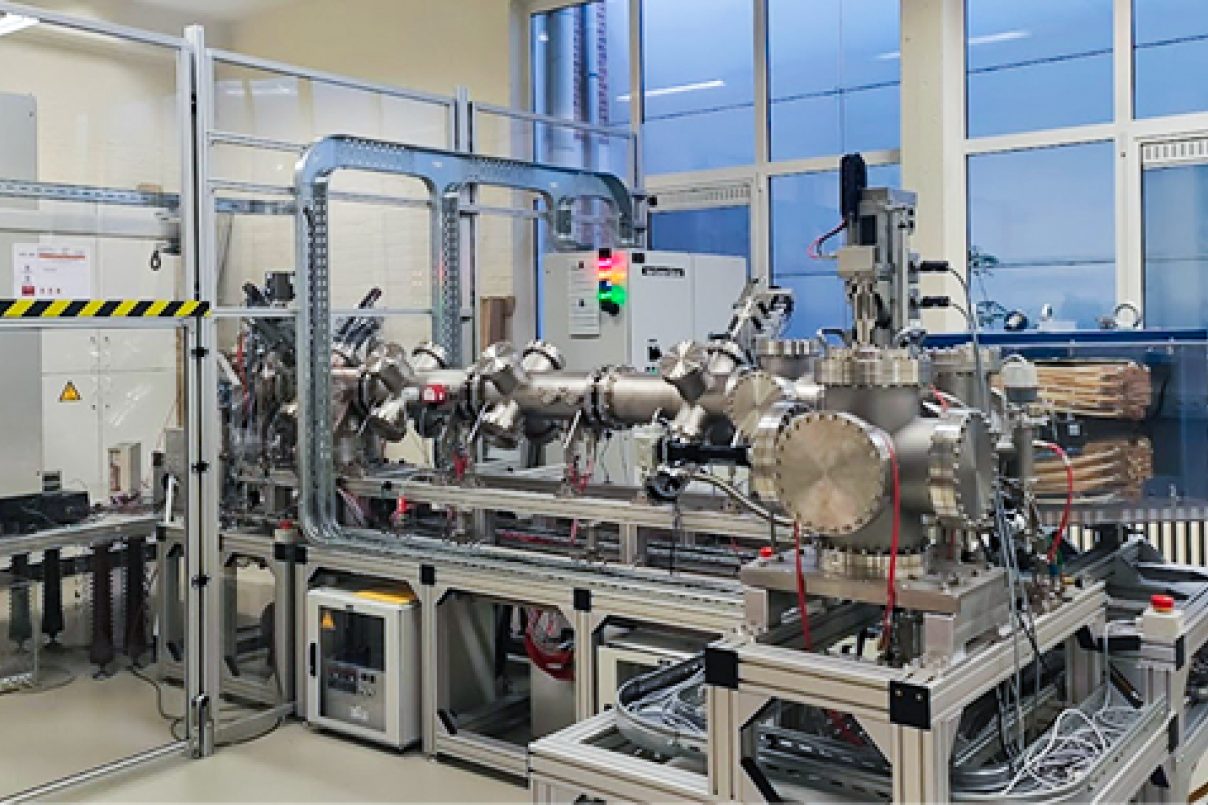
Offline ISOL system
A twin of the ISOL system which will be coupled to the MYRRHA accelerator was already constructed by the ISOL@MYRRHA team for tests and off-line operation in a dedicated laboratory at SCK CEN. In this configuration, the isotopes are not being produced and extracted on-line, during the target irradiation with a proton beam. Instead, an off-line ion source is being loaded into the system for the production of the ion beam which is then mass-separated.
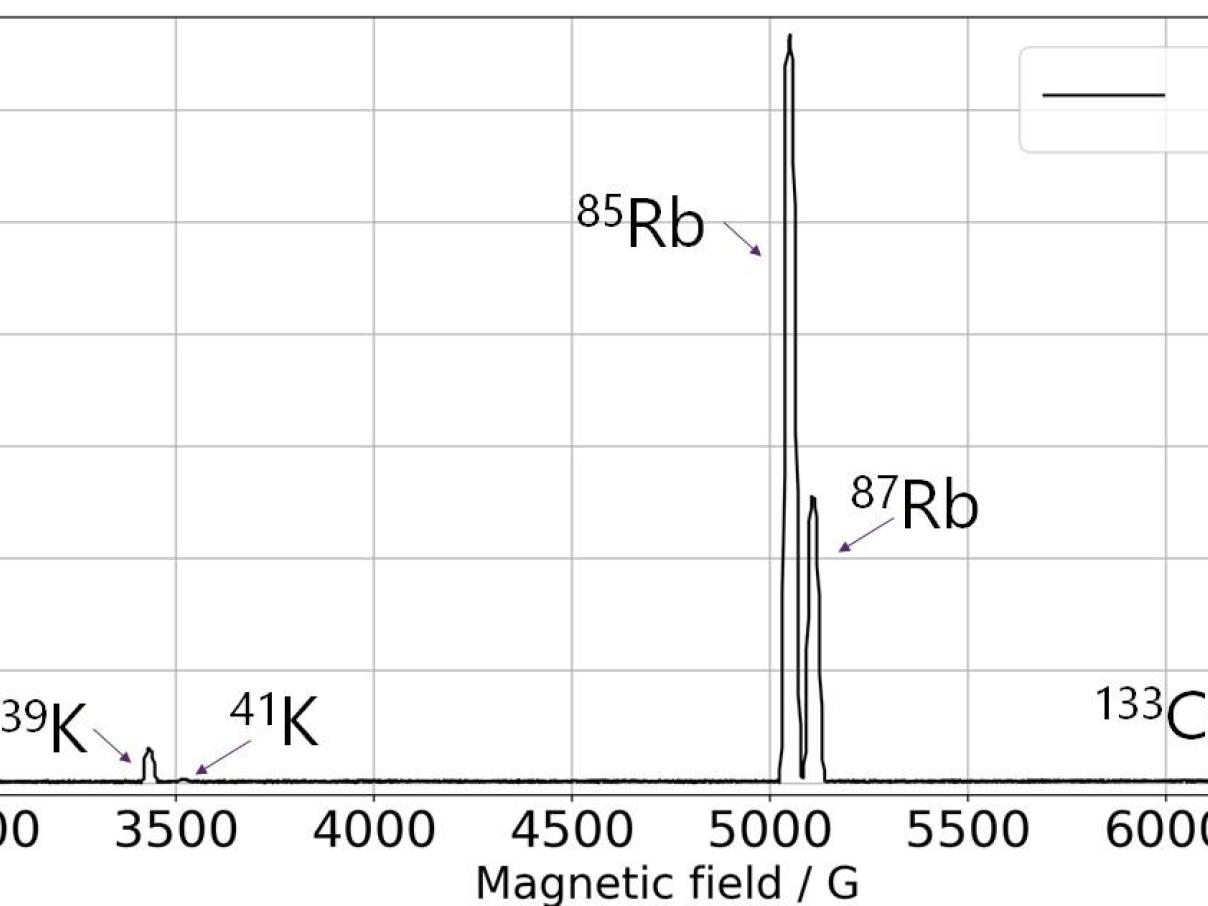
Separation of rubidium isotopes
In this test, which is part of the beam-line commissioning, the rubidium beam was produced by evaporation from a natural rubidium sample, ionization, and acceleration through applying a 30-kV potential to the ion source with respect to an extraction electrode that is grounded. The singly charged ion beam was then transported to the entrance of the electromagnetic separator using ion-beam optical elements working with electrostatic quadrupole fields.
To investigate the performance of the electromagnetic mass separator, a preliminary study was performed. Since a fixed magnetic field deflects only ions with a specific mass to the monitoring position in the focal plane of the separator, the strength of the magnetic field can be varied in order to study (mass-analyze) the composition of the beam. Thus, the naturally occurring rubidium isotopes, 85Rb (72%) and 87Rb (28%), were separated. Furthermore, other alkali metals, namely potassium and cesium, were identified as contaminants in the sample.
The test: explained step by step
-
To separate the rubidium isotopes, a sample of natural rubidium (natRb) is heated, causing the rubidium atoms to evaporate and stripping (or removing) one electron creating a positively charged ion.
-
The released ions are then exposed to a strong electric field of 30 kV, causing them to accelerate . These ions are then transported to an electromagnetic separator using ion-optical elements that operate with electrostatic quadrupole fields, which ensure the ions move in the correct direction towards the separator for further analysis.
-
A final step in the process is to separate the ions according to their masses using the electromagnetic separator, which uses a magnetic field to deflect ions with different masses at different positions. Lighter ions deflect differently from heavier ions, successfully separating the naturally occurring rubidium isotopes ⁸⁵Rb (72%) and ⁸⁷Rb (28%). In addition, small amounts of other alkali metals, such as potassium and caesium, were also detected as contaminants in the sample.
-
A fixed magnetic field deflects only ions with a specific mass to the monitoring position in the focal plane of the separator. Therefore, in order to analyze the composition of the ion beam, the strength of the magnetic field was varied. Besides the two rubidium isotopes, other alkali metals, namely potassium and cesium, were identified as contaminants in the sample.
Next steps and future research
To complete the commissioning phase, the ISOL team will further optimise and characterise the system for operation. This involves evaluating the beam emittance and determining the ideal transport conditions through the different sections of the beam line. After commissioning, the system will be used for various research projects, including the development of new target ion sources for on-line operation, separation of medical isotopes, and fundamental research.
This successful test marks a significant step towards the implementation of ISOL@MYRRHA.
💬Learn more about ISOL@MYRRHA