
PhD Defense | Evangelia Charalampopoulou | Transmission electron microscopy study on the liquid metal corrosion mechanisms of the DIN 1.4970 austenitic stainless steel fuel cladding for MYRRHA
Name: Evangelia Charalampopoulou
Research output: click here.
Date: 24 June 2026 at 4:00 p.m.
Location:
Campus Groenenborger, U.408 - Antwerpen
Transmission electron microscopy study on the liquid metal corrosion mechanisms of the DIN 1.4970 austenitic stainless steel fuel cladding for MYRRHA
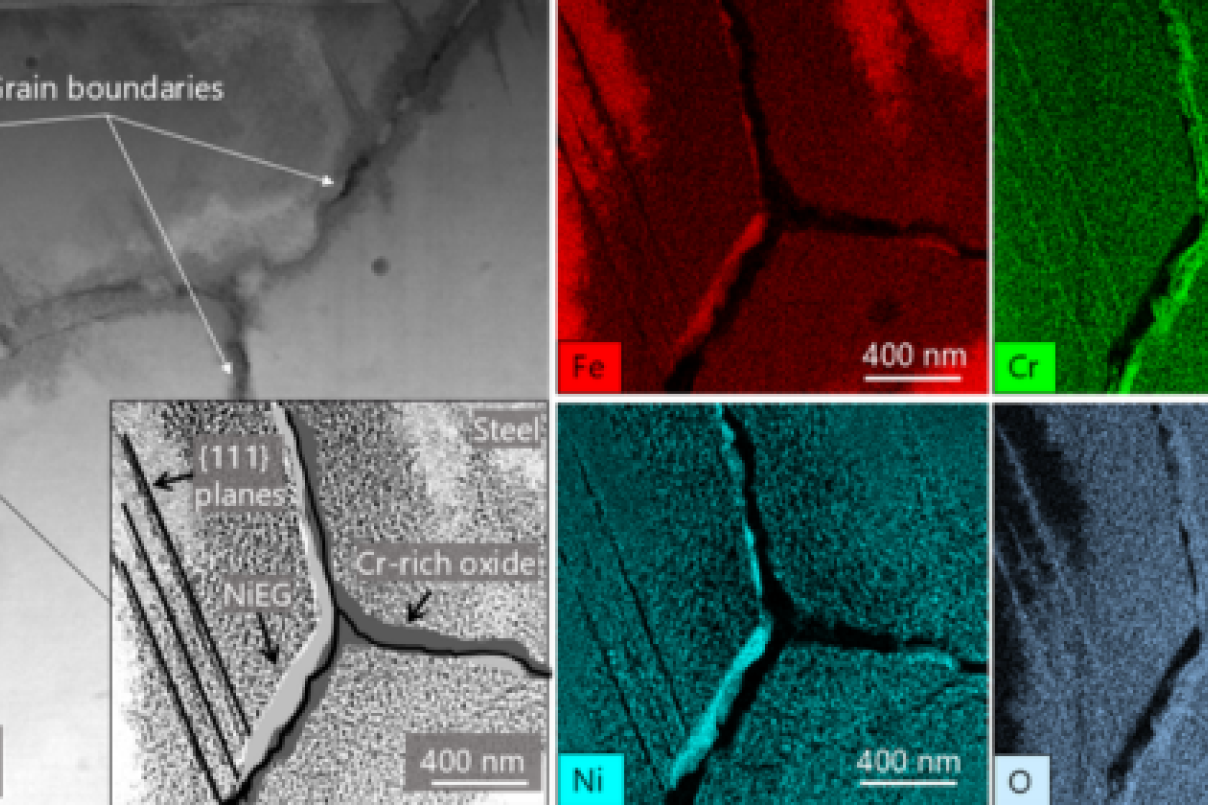
This doctoral thesis presents a detailed investigation of the liquid metal corrosion (LMC) behavior of the MYRRHA austenitic stainless steels, i.e., the DIN 1.4970 fuel cladding steel and the 316L structural steel, when exposed to the liquid lead-bismuth eutectic (LBE) MYRRHA primary coolant. The study involves the systematic investigation of dissolution and oxidation corrosion mechanisms, considering the influence of the steel microstructure and thermomechanical history, the oxygen concentration in liquid LBE, and the exposure temperature and duration. In oxygen-poor LBE environments (Co < 10⁻⁸ mass%), dissolution corrosion is dominant. Fine-grained cold-drawn steels with high density of deformation twins corrode faster than coarse-grained solution-annealed steels. Dissolution corrosion often involves selective leaching of the austenite stabilizers Ni and Mn, destabilizing the austenitic phase and leading to ferritization. An interesting finding regards the fcc-to-bcc (γ®α) phase transformation resulting from the steel exposure to liquid LBE, which follows the Pitsch orientation relationship (OR) rather than the more commonly reported Kurdjumov–Sachs (K-S) and Nishiyama–Wassermann (N-W) ORs. In the case of oxygen-rich LBE (Co > 10⁻⁶ mass%), oxidation corrosion becomes dominant. It has been found that complex oxide scales form (IOZ). Due to the inherent limitations of the active oxygen control LMC mitigation strategy that relies on the in-situ formation of protective oxide scales on the steel surface, this PhD study also tested candidate protective coatings as an alternative LMC mitigation strategy.
Promoters:
Prof. Dr. D. Schryvers, University of Antwerp
Prof. Dr. D. Lamoen, University of Antwerp
Prof. Dr. K. Lambrinou, University of Huddersfield
SCK CEN mentor:
Dr. R. Delville